
Overcoming the Deadly Force of Racism
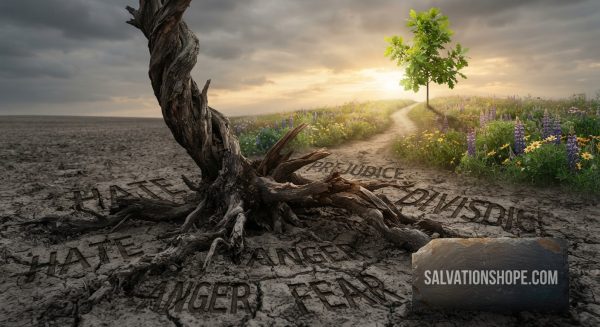
Facing the Reality of Our Brokenness
Racial hatred is a deadly force. We see its toxic roots everywhere we turn. There are white individuals who look down on Black people and other communities of color. There are Black individuals who harbor bitterness and demonize white people, Jews, and Asians.
You can hear it anywhere. Sit in a local barbershop, and you might catch angry voices griping about immigrants from Pakistan and beyond. Stand in a grocery checkout line in the United States, and you might hear a clerk complain about Hispanics taking over "our" country—even in the same breath as admitting her own parents were immigrants.
We desperately wish we could say racial conflict is a thing of the past. But it isn't. Where race relations have improved, we ought to be deeply grateful. Yet, where conflict persists among different races, tribes, and nationalities—and wherever seeds of racism still linger in our own hearts—we must face the problem squarely.
When we strip away the surface, we find a deeper, spiritual root to this crisis. When we are at odds with our fellow human beings simply because they are not like us, we are ultimately at odds with God.
The Divine Blueprint: Creation and Redemption
How can we ever hope to achieve true and lasting harmony among different kinds of people? The answer begins by getting in tune with the God revealed to us in Scripture.
In the Bible, we meet the Creator who made humanity in His own image (Genesis 1:27). As the Apostle Paul declared, "From one man he made every nation of men" (Acts 17:26). We share a single, common heritage.
We meet Jesus Christ, who poured out His blood on the cross and "purchased men for God from every tribe and language and people and nation" (Revelation 5:9). The cross of Christ shatters dividing walls and melts away hostility between different peoples (Ephesians 2:14-16).
We meet the Spirit who "does not show favoritism" (Acts 10:34) and makes His home in the hearts of believers from every background. The Spirit binds us together into one living organism—the church (1 Corinthians 12:13).
When we trust in Christ Jesus and are baptized into the triune name of the Father, Son, and Holy Spirit, Scripture tells us we "are all sons of God" and "all one in Christ Jesus" (Galatians 3:26, 28).
Called to a Supernatural Love
Because we are adopted into the same family of God, regardless of our racial, cultural, or national roots, we are given a clear calling:
"Keep on loving each other as brothers." — Hebrews 13:1
We are called to be eager not to harm one another, but rather to "serve one another in love" (Galatians 5:13).Here is the vital truth we must embrace: loving people of all races and serving across cultural divides does not come naturally to our fallen human nature. It requires a transformation that can only come supernaturally. Today, let us invite the Holy Spirit to root out every bias, fear, and hostility in our hearts, uniting us fully in the love of Christ.
Where do you need the Holy Spirit's supernatural help today to embrace someone different from you with the love of Christ?
Too Much to Swallow?
Have you ever opened the Bible, read a passage, and felt a sudden jolt—as if your mind and heart were being stretched past their absolute limits? That is because the Bible is no ordinary, everyday book. It doesn't fit comfortably into our natural thought patterns. It introduces us to a God we hardly know and gives us a whole new way of seeing things. It says things that can be profoundly difficult to believe.
Sometimes, things in Scripture are hard to swallow because they are astonishingly supernatural. Other times, they are hard to swallow simply because they deeply upset us, challenging our comfort zones and our prejudices.
The Miracle and the Mercy
Take the classic biblical story of Jonah, for example. Scripture tells us that when Jonah tried to run away from God’s call, a massive storm threatened his ship. God intervened, rescuing Jonah from drowning by sending a great fish to swallow him. Jonah lived for three days and three nights inside that fish, and then—in a display of raw, divine power—the fish vomited Jonah out onto dry land, alive and uninjured.
Now, that is not the sort of thing that happens every day! For many, it is simply too miraculous, too supernatural to take literally. Yet, for all the debate surrounding the great fish, that is actually not the hardest part of the story. The real hurdle comes in what happens next.
God compelled Jonah to go to Nineveh, the capital city of Assyria—his nation’s most hated enemy. Jonah was tasked with warning these brutal oppressors of impending divine judgment. To Jonah's absolute horror, the Ninevites actually repented, humbling themselves and begging God for mercy.
And how did God respond? Scripture tells us the Lord “had compassion and did not bring upon them the destruction he had threatened” (Jonah 3:19).Jonah was furious. He snarled, “I am angry enough to die” (Jonah 4:9).This angry prophet wanted God to favor him and his own people. He was utterly outraged that God would show kindness to these foreign adversaries who had a long, bloody history of making life miserable for Jonah’s countrymen. But God cared about Nineveh. He looked at Jonah and asked a piercing question that echoes down to us today: “Should I not be concerned about that great city?” (Jonah 4:11) The book of Jonah ends right there, leaving all of us standing in the quiet, forced to ponder God's searching question.
Expanding Small Minds and Small Hearts
Here is the truth we often find too much to swallow: God cares about groups of people we don’t like. He cares about them just as much as he cares about us and our group.
In fact, that reality can be much harder for our spirits to swallow than a fish was for Jonah! After all, if God truly cares about people we hold animosity toward, then if we belong to God, we are expected to stop hating and start caring too.
That feels like too much to ask. It feels much easier to just hang on to our bitterness, our tribalism, and our prejudices.
“The problem is with us, not with the Bible. It was no problem for the God who creates men and fish to keep Jonah safe... the only problem is if our minds are too small to grasp God’s power. Likewise, it’s no problem for the loving God who created all people to care about others... the only problem is if our hearts are hard, too small to love people whom God loves.”
When we truly listen to the Bible and believe what it says, something miraculous happens. God expands our minds to recognize His infinite power, and He expands our hearts to embrace His boundless love.
A God Who Takes No Sides
Jonah was a man trapped by his own prejudices. He wasn’t just angry at the foreigners; he was angry at God for loving those foreigners. Whether Jonah liked it—or whether we like it today—the Lord insists on caring about people of every kind. God does not side with one tribe, one race, or one nation against another.
With God’s persistent help, Jonah finally confronted his own heart and preserved this story so that we could learn from his mistakes. God cares about the groups we struggle to love just as much as He cares about us. The deeper we dive into His Word, the clearer and more convicting that truth becomes. As we read this today, let us take God's question to heart: Are our hearts ready to expand?
What is one area where God might be inviting you to expand your heart to love someone outside your comfort zone?
Foreigners Included
Welcome and Invocation
Today, we can look at God's Word to confront a deeply rooted, destructive human habit: the sin of tribalism and racism. From the Old Testament to the ministry of Jesus and the early church, God has consistently challenged our narrow human boundaries. Let's take a look at how Scripture shatters our divisions and declares an unmistakable truth: God’s family includes people of every race and nation.
The Biblical Witness: A Heritage Without Borders
Right from the pages of Scripture, we see God breaking down the walls we try to build:
Moses, the great leader of Israel, married a woman from Africa. His own sister Miriam and brother Aaron were upset by this and spoke against him (Numbers 12:1). Yet, God's anger burned against their prejudice until they sought forgiveness.
In the book of Jeremiah, we meet Ebed-Melech, a Cushite (an African from modern-day Ethiopia). While the corrupt leaders of Jerusalem let the prophet Jeremiah rot in a muddy pit, this brave African foreigner spoke out, rescued God's prophet, and received a divine promise: "I will save you... because you trust in me" (Jeremiah 39:18).
Long before Jesus walked the earth, Isaiah proclaimed that God's house would not be an exclusive club. God declared, "My house will be called a house of prayer for all nations" (Isaiah 56:7), explicitly telling foreigners not to fear exclusion.
The Confrontation at Nazareth: When Grace Offends
When Jesus began his public ministry, God's radical inclusiveness became clearer than ever—and so did the backlash of angry racists. In Luke 4, Jesus visited his hometown of Nazareth. At first, the crowd was thrilled with their talented hometown boy. But Jesus touched a sore spot. He reminded them that during famines and plagues, God sent prophets to bless outsiders—like the Sidonian widow helped by Elijah, or Naaman the Syrian healed by Elisha.
Jesus was driving home a piercing point: Race and nation don't count for much in God's eyes. You can be born in the "wrong" place and be singled out for blessing, while someone from the "right" background can be entirely out of tune with God.
How did the hometown crowd respond? They didn't fall to their knees in repentance. They formed a lynch mob, determined to throw him off a cliff. Angry racists don’t just hate foreigners; they hate the Lord himself for choosing to show mercy outside their preferred circles.
An Equal-Opportunity Sin
Throughout the book of Acts, we see this hostility playing out from all sides:
A Vital Truth:
Racism is an equal-opportunity sin. People of every race and background harbor a sinful tendency to elevate their own group above others. Sadly, even those who claim to follow Scripture have often turned a blind eye to it, practicing dreadful racism and reacting with hostility when challenged.
Call to Change
No matter how angry people get, God does not change, and His Word does not change. God’s standard remains clear: "God does not show favoritism but accepts men from every nation who fear him and do what is right" (Acts 10:34-35). Human hearts can change, however, when we truly listen to God speak through His Word, Let us examine our own hearts today:
Where might we still be drawing lines that God has long since erased?
The Multiracial Multitude: A Heavenly Calling
Beyond the Dividing Walls
What about you? What is your attitude toward people who are not like you? How do you feel about those from a different country, a different culture, or a different skin color?
When we hold onto contempt, indifference, or hostility toward people who differ from us, we are not merely clashing with our neighbors. Scripture reminds us that we are fighting against God Himself. And when anyone goes up against the Almighty, the outcome is already decided. Why choose to resist the Creator? Why not turn toward grace?
Washed in One Blood
The cross of Christ levels every human distinction. The blood of Jesus washes away sin, and it does so for people from every tribe, language, and nation.
Living in harmony with God's design brings a joy that far surpasses the bitter, sour spirit of prejudice.
A Glimpse of Heaven Today
Embracing God's diverse family is an enriching, joyous journey. None of us has arrived completely; learning to fully appreciate and honor distinct cultural backgrounds is a lifelong growth process. Yet, the reward is immense.
Sharing life with brothers and sisters from across the globe—whether roommates from different continents, colleagues from diverse ethnic backgrounds, or global students in the classroom—offers a breathtaking foretaste of eternity. This many-colored mosaic of faith is a living window into heaven.
"After this I looked, and there before me was a great multitude that no one could count, from every nation,
tribe, people and language, standing before the throne and before the Lamb." — Revelation 7:9
Joining the Endless Song
To truly long for heaven is to long for a multiracial multitude. If a heart demands an eternity built exclusively around "one's own kind," it looks for something heaven does not offer. Heaven is vast, global, unified, and wonderfully diverse. As the old hymn of heaven reminds us: Here from all nations, all tongues, and all peoples, Countless the crowd but their voices are one. Vast is the sight and majestic their singing: “God has the victory: he reigns from the throne!”
What is one step you can take this week to intentionally connect with or appreciate someone from a culture or background different from your own?