
Satan-Demons
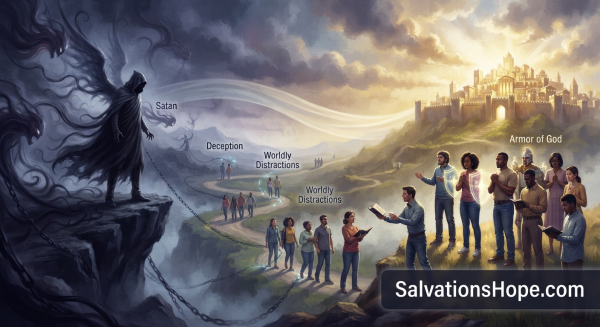
The Identity and Strategy of the Adversary
In biblical teaching, understanding the spiritual landscape involves recognizing the active opposition of Satan, a central figure of spiritual darkness. To effectively navigate Christian life and witness, believers must comprehend both who the adversary is and how his influence operates in the world.
The Nature and Origin of Satan
Satan is not merely an abstract symbol of evil or a cosmic force of impersonal energy; rather, he is a personal, spiritual being.
- Created Intelligence: Possessing intellect, will, and emotion, he was originally created by God as a high-ranking spiritual entity.
- Cosmic Rebellion: Through an act of pride and willful defection, he rebelled against the sovereignty of God, choosing to set his own agenda in direct opposition to his Creator.
- The Fallen Hierarchy: Following his fall, he established a spiritual kingdom. This domain is organized and populated by demonic powers—fallen spiritual entities that actively assist him in opposing the purposes, justice, and grace of God across human history.
Primary Objectives of the Adversary
The ongoing opposition orchestrated by Satan and his forces is strategically directed toward two primary, overarching targets:
- Inhibiting the Unsaved: A principal goal is to keep men and women separated from God’s kingdom. This is accomplished through intellectual deception, cultural blindness, and the promotion of alternative worldviews that obscure the truth of the gospel, preventing individuals from experiencing spiritual rebirth and reconciliation with God.
- Neutralizing the Believer: For those who have already entered God's kingdom, the adversary’s strategy shifts from prevention to neutralization. Rather than targeting eternal salvation—which is secure—the focus turns to undermining temporal effectiveness. This is executed through various “schemes” designed to:
- Induce spiritual complacency and hinder ongoing sanctification, keeping Christians in a state of spiritual immaturity.
- Breed division, doubt, moral compromise, and discouragement within the community of faith.
- Disrupt the active proclamation of the gospel, rendering believers ineffective in fulfilling the Great Commission and engaging a watching world for Christ.
Recognizing these spiritual realities equips believers to stand firm, utilizing the spiritual armor and resources provided by God to discern deception, pursue maturity, and advance the gospel with confidence.
Unveiling the Adversary
A Biblical Theology of Satan and Demons
Welcome to this comprehensive study on the biblical presentation of Satan and demonic forces. Across the pages of Scripture, the reality of a spiritual realm hostile to God and His purposes is systematically revealed. This article serves as an in-depth guide to understanding how the concept of the adversary develops from the early shadows of the Old Testament to the clear, unveiled spiritual warfare detailed in the New Testament.
The Old Testament Foundation: Accusation and Testing
While the New Testament provides a fully developed demonology, the Old Testament lays essential groundwork by introducing key motifs regarding the adversary (ha-satan).
- The Accuser and Prosecutor: In early texts such as Job and Zechariah, the term often functions as a title rather than a proper name, depicting a celestial figure who stands in the heavenly court to accuse humanity or test divine justice.
- Subtle Temptation: Genesis 3 introduces a deceptive serpent whose cunning assault targets human trust in God's goodness, establishing a pattern of temptation that echoes throughout biblical history.
- Progressive Revelation: The Old Testament data is intentionally restrained, keeping the focus strictly on the sovereignty of God while slowly pulling back the curtain on an active, malicious opponent of divine order.
Cosmic Rebellion and Demonic Forces
Moving from the Hebrew Bible to the New Testament, the identity and scope of spiritual opposition become sharply focused.
- The Fall of Angels: Scripture indicates that Satan was once an exalted heavenly being who fell through pride and rebellion, dragging a cohort of angelic entities—now known as demons or evil spirits—into his defection.
- Principalities and Powers: The New Testament expands our vocabulary for the unseen realm, utilizing terms like rulers, authorities, and cosmic powers to describe an organized, malevolent hierarchy operating within the fallen world system.
- Imitation and Deception: Unlike the localized opposition seen in earlier texts, New Testament authors depict Satan and his forces as actively blinding the minds of unbelievers and masquerading as angels of light to propagate spiritual falsehood.
The Decisive Defeat of Satan
A central pillar of Christian theology is that the powers of darkness have already suffered a fatal, decisive blow through the redemptive work of Jesus Christ.
- The Incarnation and Ministry: Christ’s earthly ministry, culminating in His temptations in the wilderness and His casting out of demons, served as a direct assault on Satan’s dominion.
- The Cross as Victory: Colossians and other Pauline epistles declare that the cross was not a tragedy, but a triumph—disarming principalities and publically putting them to shame.
- Eschatological Certainty: While the adversary remains active during the present church age, biblical prophecy assures believers of his ultimate, eternal doom in the lake of fire, ending his rebellion once and for all.
Contemporary Strategies: Opposing Evangelism and Growth
Understanding the nature of spiritual opposition is vital for practical Christian living and ministry today. Satan’s strategies are rarely theatrical; rather, they are calculated to disrupt the mission of the Church.
- Hindering Gospel Proclamation: The adversary actively seeks to blind unbelievers, snatch away the sown word of God, and erect cultural or ideological barriers to stop the spread of the gospel.
- Subverting Spiritual Maturity: Within the body of Christ, demonic schemes manifest as division, false doctrine, apathy, and moral compromise designed to stunt the sanctification and fruitful growth of believers.
- Equipping for Resistance: Recognizing these tactics drives Christians to rely on spiritual armor, prayer, and the truth of Scripture, standing firm against a defeated foe who still fights desperately against the advancing Kingdom of God.
The Evolution of the Adversary
Satan in the Old Testament
When examining the concept of Satan within the Hebrew Bible (Old Testament), it is essential to first understand the linguistic roots of the term. The Hebrew word satan (שטן) is not originally a proper name, but a common noun meaning “adversary,” “opponent,” or “accuser.” In its earliest and most mundane usages, it refers to human antagonists in political or military contexts.
For instance, King Solomon’s political opponents are described using this term: “Then the Lord raised up against Solomon an adversary (satan), Hadad the Edomite…” (1 Kings 11:14; see also vv. 23, 25). Even an angel of the Lord acting to block the path of the disobedient prophet Balaam functions as a satan (Numbers 22:22).
However, over the course of Israel’s theological development, the term transitions from a general functional role into a specific, transcendent, supernatural figure. While the Old Testament portrayal of this figure is far more restrained and nuanced than the fully developed demonology of the New Testament, it establishes critical foundational concepts regarding divine sovereignty, spiritual opposition, and cosmic accountability.
The Accuser in the Heavenly Court: Job 1–2
The most prominent and dramatic depiction of this supernatural figure occurs in the prologue of the book of Job. Here, the term appears with the definite article: ha-satan (“the Adversary” or “the Accuser”), indicating an official role or title within the heavenly council rather than a proper personal name.
- The Heavenly Setting: In Job 1:6, the bene elohim (“sons of God” or divine beings) present themselves before Yahweh, and “Satan also came with them.”
- The Skeptical Challenge: When Yahweh praises Job as “blameless and upright, a man who fears God and shuns evil” (Job 1:8), Satan cynically challenges the motivation behind Job’s piety. He argues that Job’s righteousness is merely transactional, maintained only because of divine hedge-protection and material prosperity: “Does Job fear God for nothing?” (v. 9).
- The Boundaries of Testing: Satan demands permission to test Job’s character by stripping away his blessings: “But now stretch out your hand and strike everything he has, and he will surely curse you to your face” (v. 11).
Importantly, this text establishes a vital theological boundary: Satan possesses no autonomous power. He must request permission from Yahweh, and his destructive actions are strictly circumscribed. His ultimate purpose is not merely to cause physical or economic pain, but to subvert human loyalty, forcing Job to curse God (1:11; 2:5) and thereby proving that genuine, unselfish faith does not exist.
The Cosmic Prosecutor: Zechariah 3
A similarly transcendent, heavenly portrayal appears in the post-exilic prophetic literature, specifically in the visions of Zechariah. In chapter 3, the prophet is granted a window into the heavenly realm during a critical moment of restoration for the Jewish community returning from Babylon.
- The Courtroom Scene: Zechariah sees Joshua the high priest standing before the angel of the Lord, while "Satan standing at his right side to accuse him" (Zech. 3:1). In ancient legal settings, the accuser or prosecutor stood at the right hand of the accused.
- The Basis of Accusation: Joshua represents the post-exilic community, burdened by historical guilt, religious failure, and present impurity (symbolized by his "filthy garments," v. 3). Satan’s accusation is legally and factually grounded in Israel's actual sin.
- Divine Overruling: Rather than denying the guilt, Yahweh intervenes directly, rebuking Satan with the declaration: "The Lord rebuke you, Satan! The Lord who has chosen Jerusalem, rebuke you!" (v. 2).
- Symbol of Grace: The subsequent changing of Joshua's garments (vv. 4–5) acts as a dramatic enactment of forensic justification, cleansing, and reinstatement.
In this passage, Satan functions as a prosecuting attorney in a cosmic court. Yet, the prophetic vision underscores that divine grace, election, and sovereign purpose ultimately triumph over every legal accusation.
The Instigator of Sin: The Theological Tension of the Census
Beyond his role as a heavenly accuser and tester, the Old Testament occasionally portrays Satan as an active tempter and inciter of human sin. A fascinating theological tension arises when comparing two parallel accounts of King David’s disastrous decision to conduct a military census:
1 Chronicles 21:1: "Satan rose against Israel and incited David to take a census of Israel."
2 Samuel 24:1: "Again the anger of the Lord burned against Israel, and he incited David
against them, saying, 'Go and take a census of Israel and Judah.'"
Reconciling the Accounts
At first glance, these verses appear to attribute the exact same instigation to two different sources: Satan in Chronicles, and Yahweh in Samuel. This highlights the unique Hebrew worldview regarding primary and secondary causality.
- Satan's Malicious Intent: Satan acts as the direct tempter, pushing David toward pride, self-reliance, and militarism (as recognized by Joab's rebuke). Satan's motive is destructive—to cause harm to God's people by leading their leader into sin.
- Yahweh's Sovereign Permission: In the older theology of Samuel, God is viewed as the ultimate sovereign behind all historical events, sometimes permitting or deploying testing agents to discipline an unfaithful nation.
Therefore, while Satan operates out of malice to incite sin, he remains on a strict leash, ultimately subordinated to Yahweh’s overarching and righteous purposes. Even when acting maliciously, Satan becomes an unwitting instrument within the grander tapestry of divine governance and discipline.
The Foundation for the New Testament
The Old Testament portrait of Satan is intentionally restrained. Unlike dualistic religious systems of the ancient Near East—where good and evil deities battle as equals—the Hebrew Bible maintains strict, uncompromising monotheism. Satan is never a co-eternal, independent rival to God; he is a creature, a member of the heavenly council, a legal prosecutor, and a tempter who operates entirely under the sovereign permission of Yahweh.
By establishing these core motifs—the adversarial tester in Job, the heavenly accuser in Zechariah, and the malicious instigator in Chronicles—the Old Testament lays the theological groundwork for the fully developed doctrine of Satan and demonic forces seen in the New Testament.
The Evolution of Darkness
Satan and Demons in the New Testament
When studying biblical angelology and demonology, a distinct theological shift becomes apparent between the Old and New Testaments. While the Old Testament contains sparse references to adversary figures and spiritual opposition, the New Testament presents a significantly expanded, cohesive, and urgent picture of an organized kingdom of darkness. This realm is directed by a central antagonist and populated by a hierarchy of malignant spiritual forces.
The Identity and Authority of Satan
In the New Testament, Satan (frequently designated by alternative titles such as Beelzebub) is systematically portrayed as the supreme ruler of a dark, spiritual empire. Rather than a vague or abstract concept of evil, he is depicted as a personal, intelligent entity who commands absolute submission from subordinate demonic powers.
- "The Prince of Demons": In the Synoptic Gospels, religious authorities accuse Jesus of casting out evil spirits by the power of Beelzebul, whom they recognize as the "prince of demons" (Matthew 9:34; 12:24; Mark 3:22; Luke 11:15). Jesus' counter-arguments do not deny the existence of this hierarchy, but rather expose the internal contradiction of a divided kingdom.
- "The Prince of This World": In the Johannine corpus, Jesus repeatedly refers to Satan as the "ruler" or "prince of this world" (John 12:31; 14:30; 16:11). This title underscores Satan’s systemic, pervasive influence over fallen human structures, cultural opposition, and the current age alienated from God.
Nomenclature: Understanding Demonic Entities
The New Testament utilizes a rich vocabulary to describe these malignant beings, with each term offering a unique lens through which to view their nature and operational methods:
- Demons (daimonia) and Spirits (pneumata): The most common designations, identifying these entities as active, invisible spiritual agents capable of exerting influence over human minds, bodies, and behaviors.
- Evil Spirits and Unclean Spirits: These modifiers emphasize the absolute moral corruption and spiritual defilement inherent in these entities, standing in direct contrast to the Holy Spirit.
- Deceitful Spirits: A designation highlighting their strategic methodology, which relies heavily on deception, false teaching, and drawing individuals away from spiritual truth.
Cosmic Hierarchies: "Principalities and Powers"
Beyond individual instances of demonic influence, the New Testament writers frequently employ macro-level terminology to describe the invisible architecture of evil. Phrases like “principalities and powers” (archai and exousiai) point to organized, personal spiritual beings.
These cosmic forces operate behind the scenes of human history, culture, and sociopolitical structures, actively seeking to subvert divine purposes and hinder the redemptive work of Christ. Despite their formidable scope and influence, the New Testament uniformly affirms that these powers were decisively defeated at the cross and remain subject to the ultimate authority of Jesus.
The Origins of Evil
Understanding the Rebellion of Satan and His Followers
When exploring the origins of darkness, suffering, and spiritual opposition in the biblical narrative, a foundational theological truth must be established: Christianity rejects eternal dualism. Unlike dualistic worldviews that posit two co-equal, co-eternal, and competing forces of absolute good and absolute evil, biblical monotheism maintains that God alone is uncreated, self-existent, and sovereign over all reality.
Satan and his demonic hosts are not eternal counterparts to God. Rather, they are created beings who originally occupied a pristine, holy status within the heavenly hierarchy before choosing a path of rebellion prior to the dawn of human history.
The Pristine Creation of Spiritual Powers
To understand the fallen state of demonic forces, we must first look to their origin. The Apostle Paul provides a sweeping cosmological statement in Colossians 1:16:
"For in him all things were created: things in heaven and on earth, visible and invisible, whether
thrones or powers or rulers or authorities; all things have been created through him and for him."
In this passage, Paul dismantles any notion that evil entities were independently created or eternal. He highlights several crucial realities:
- Total Sovereignty: Everything that exists—both the physical universe ("on earth") and the spiritual realm ("in heaven")—owes its existence to Jesus Christ.
- Hierarchical Structure: Paul lists specific administrative or structural terms—thrones, powers, rulers, and authorities—denoting that God established an intricate, organized heavenly realm filled with spiritual beings endowed with agency, intellect, and capacity for worship.
- Original Goodness: Because these beings were created through Christ and for Christ, they were originally declared good. They were designed to reflect God’s glory, serve His divine purposes, and exist in harmonious alignment with their Creator.
The Cosmic Fracture: Disharmony in the Heavenly Realms
If creation was originally flawless, how did darkness enter the spiritual domain? The answer lies in the catastrophic moral fracture that preceded human history, resulting in a rebellion that corrupted a portion of the heavenly host.
Paul hints at this cosmic disruption later in the same passage (Colossians 1:19–20):
"For God was pleased to have all his fullness dwell in him, and through him to reconcile to himself all
things, whether things on earth or things in heaven, by making peace through his blood, shed on the cross."
The inclusion of “things in heaven” alongside “things on earth” as objects of divine reconciliation carries profound theological implications:
- The Need for Reconciliation: Reconciliation is only necessary where there is alienation, hostility, or rebellion. The fact that the heavenly realms require peace-making through the blood of the cross indicates that a severe moral breach occurred within the spiritual domain.
- The Shift from Good to Demonic: While these celestial powers were created without sin, a decisive change occurred. Influenced by pride and a desire to usurp divine authority, a faction of these beings turned away from God, transforming into demonic entities operating under the dominion of "the prince of demons" (Satan).
Prophetic Insights: Glimpses of the Fall in Isaiah and Ezekiel
While the New Testament clearly asserts the reality of angelic rebellion, biblical scholars often look to two major Old Testament passages—Isaiah 14 and Ezekiel 28—for descriptive windows into the mechanics of this primordial fall.
Although these passages are historically and primarily addressed to earthly rulers (the King of Babylon and the King of Tyre, respectively), many theologians recognize a typological or double-fulfillment layer operating beneath the text. The hyperbole and cosmic language exceed the boundaries of ordinary human experience:
- The King of Babylon (Isaiah 14:12–14): The text speaks of one who fell from heaven, who was once "Morning Star, son of the dawn," but whose heart was corrupted by ultimate arrogance: "I will ascend to the heavens; I will raise my throne above the stars of God... I will make myself like the Most High." This language captures the psychological and spiritual blueprint of Satan's original rebellion—an attempted coup against the sovereignty of God.
- The King of Tyre (Ezekiel 28:11–19): This passage describes a figure who was "in Eden, the garden of God," adorned with every precious stone, and designated as "the anointed guardian cherub." Yet, pride was found in him because of his beauty, leading to his expulsion from the holy mountain of God. Scholars note that describing a Phoenician monarch as an Edenic guardian cherub points past the earthly king to the spiritual mastermind—Satan—who energized and inspired the tyranny of human empires.
Summary for Teaching and Reflection
- God is the Creator of all: No evil entity exists outside of God's sovereign creation, meaning evil is an parasitic corruption of something originally good, not a co-equal substance.
- Free agency brought catastrophe: Angelic beings, possessing genuine moral agency, chose to rebel against their Creator.
- Christ’s ultimate victory: The cosmic rebellion is not permanent. Through the cross, Christ has secured the ultimate reconciliation and final subjugation of all rebellious powers, ensuring that God's original, good purposes will ultimately be restored across both heaven and earth.
The Defeat and Final Judgment of Satan
The narrative of Scripture presents a grand overarching theme: the systematic dismantling and ultimate overthrow of the dominion of darkness through the redemptive work of Jesus Christ. Far from being a sudden or isolated event, the victory over Satan and his spiritual forces is revealed throughout the New Testament as a multi-stage progression. This spiritual triumph unfolds across four distinct phases, beginning with the earthly life of Christ and culminating in the eternal restoration of creation.
The Foundation of Moral Resilience: The Wilderness Temptation
The initial blow against the adversary’s supremacy occurred during the temptation of Jesus in the wilderness. When confronted by the instigator of rebellion, Jesus did not rely on divine prerogatives alone; instead, He anchored His defense entirely in the authoritative truth of Scripture.
- Standing Firm in Obedience: By choosing submission to divine instruction over immediate comfort or worldly power, Christ preserved His absolute moral perfection.
- Qualifying the Sacrifice: This unbroken obedience was essential. To serve as an acceptable, spotless substitute for humanity, the Savior had to successfully navigate the testing ground where humanity's first representative originally failed. By passing this test, Jesus established the moral foundation required to offer Himself as the ultimate sacrifice for human transgression.
The Advance of the Divine Rule: Ministry and Exorcisms
Throughout His active ministry, Jesus systematically dismantled the strongholds of darkness through His teaching, healing, and casting out of demons. The public proclamation of God’s reign invited individuals out of allegiance to the opposing kingdom and into joyful submission to the Creator.
- The In-Breaking Kingdom: Jesus explicitly connected His power over spiritual forces to the active presence of God’s rule. Every instance of liberation from demonic oppression served as a direct confrontation against the powers of darkness.
- Signs of the Age to Come: Rather than isolated displays of power, these dramatic interventions demonstrated that the anticipated eschatological defeat of evil was actively breaking into human history, signaling the superior authority of the divine realm over the forces of spiritual rebellion.
The Decisive Turning Point: The Cross and the Empty Tomb
While the earthly ministry of Jesus steadily pushed back the boundaries of darkness, the cross and the resurrection marked the decisive, irreversible defeat of Satan and his cosmic hierarchy.
- Legal and Spiritual Emancipation: The crucifixion accomplished far more than the cancellation of human guilt; it executed a cosmic restructuring. The legal accusation held against humanity was permanently neutralized, stripped of its power, and publicly nullified.
- Disarming the Authorities: The spiritual powers that once held humanity in bondage were stripped of their authority and led in a spiritual triumph, exposed as defeated foes.
- The Exalting Resurrection: The resurrection and subsequent ascension of Christ solidified this victory. By being exalted to the highest place of honor, Jesus placed all angelic rulers, authorities, and cosmic powers in a position of ultimate subjection beneath His supreme authority.
The Ultimate Consummation: The Future Judgment
Although the decisive battle has been won, believers currently live in the interim period between the inauguration of Christ’s kingdom and its absolute realization. The New Testament maintains a confident expectation that the adversary’s remaining influence will be utterly eradicated.
- The Immediate Hope: New Testament writers frequently encouraged local congregations with the promise that the God of peace would soon shatter the power of evil underneath the feet of His people.
- The Final Eternal Justice: This anticipation looks forward to the final historical epoch when the instigator of rebellion, alongside all corrupt systems and deceptive ideologies, will be permanently removed from the universe and consigned to eternal justice.
Summary for Teaching and Study
Phase of Victory
Primary Focus
Scriptural Anchor Theme
Phase 1
Wilderness Temptation
Perfect obedience and qualification for sacrifice
Phase 2
Earthly Ministry
Advance of the kingdom through teaching and liberation
Phase 3
The Cross & Resurrection
Disarming of cosmic authorities and public triumph
Phase 4
The Final Judgment
Total eradication of evil and eternal restoration
Through these four interconnected movements, the Christian worldview provides a robust framework of hope: evil is neither eternal nor sovereign, but has been decisively conquered and will ultimately be brought to a permanent end under the feet of the Almighty.
Understanding the Adversary
Satan’s Schemes and Demonic Forces
Although Satan and his demonic hierarchy were decisively and irrevocably defeated at the cross, they remain active agents of opposition against God’s sovereign will and redemptive purposes during this present age. Recognizing this reality is essential for every believer navigating the landscape of spiritual warfare. The enemy’s strategic playbook targets both the spiritually lost and the spiritually mature, operating through calculated methodologies designed to subvert divine truth, hinder human flourishing, and derail the mission of the Church.
Phase One: Targeting the Lost — The Battle for the Gospel
The primary objective of Satan’s earthly operations is to prevent men and women from hearing, understanding, and responding in faith to the proclamation of the gospel. Because unregenerate humanity is spiritually dead in trespasses and sins, the adversary exercises a temporary, localized influence over those who are disobedient (Ephesians 2:2).
The stakes of this conflict are cosmic in scale:
- The Transfer of Kingdoms: When an individual places saving faith in Christ, they are immediately rescued from the dominion of darkness and transferred into the kingdom of God's beloved Son (Colossians 1:13; Acts 26:18).
- The Loss of a Subject: Every conversion represents a direct loss for Satan's kingdom and the gain of a devoted child for Christ. Consequently, demonic forces deploy intensive measures to intercept the message of salvation.
The Mechanics of Blinding
Apostle Paul identifies a primary mechanism of this opposition in 2 Corinthians 4:4:
"The god of this age has blinded the minds of unbelievers, so that they cannot
see the light of the gospel of the glory of Christ, who is the image of God."
This spiritual blindness is not merely intellectual; it is an active, perceptual obstruction. It aligns directly with the spiritual reality Jesus illustrates in the Parable of the Sower:
"Some people are like seed along the path, where the word is sown. As soon as they hear it, Satan
comes and takes away the word that was sown in them" (Mark 4:15; Matthew 13:19; Luke 8:12).
By exploiting cultural distractions, rationalistic skepticism, emotional hardness, and deceptive philosophies, the enemy works tirelessly to snatch the seed of truth before it can take root in an open heart.
Phase Two: Targeting the Believer — The Plurality of "Schemes"
Because the Church represents the frontline of gospel proclamation, corporate and individual evangelism is a primary theater of spiritual warfare. However, Satan’s opposition does not cease at conversion. Once a person belongs to Christ, the adversary pivots from trying to prevent salvation to attempting to neutralize spiritual growth, stunt ministry effectiveness, and dismantle Christian unity.
In 2 Corinthians 2:11, Paul warns the community of faith that Satan desires to “outwit” believers, emphasizing that we must not be “unaware of his schemes.” Similarly, believers are commanded to put on the full armor of God so they can “stand your ground against the devil’s schemes” (Ephesians 6:11, 13).
- The Significance of "Schemes" (Noēmata): The use of the plural implies that the adversary does not rely on a single, uniform tactic. Instead, he employs a sophisticated, adaptable variety of strategies tailored to exploit individual vulnerabilities, cultural moments, and corporate blind spots.
- Scriptural Insight: While the Bible outlines several prominent schemes, these references are representative rather than exhaustive, underscoring the need for perpetual spiritual discernment and biblical literacy.
Scheme One: Strategic Deception
Among the most destructive and pervasive schemes detailed in Scripture is deception. Satan is fundamentally characterized as “the deceiver” or the one who leads the whole world astray (ho planōn, Revelation 12:9). Jesus unmasks the core nature of the adversary in John 8:44:
"He was a murderer from the beginning, not holding to the truth, for there is no truth in him.
When he lies, he speaks out of his own character, for he is a liar and the father of lies."
This scheme operates on multiple distinct fronts within the life of individuals and the broader Church:
- Doctrinal Deception: The enemy infiltrates communities of faith by promoting theological error, syncretism, and distorted interpretations of Scripture. Paul labels these systemic perversions as "teachings of demons" (1 Timothy 4:1), designed to subtly draw believers away from the sufficiency of Christ and the authority of the Word.
- Personal Deception: On an individual level, deception targets identity, perception, and consequence. The enemy whispers lies that undermine a believer's secure identity in Christ, cultivating feelings of unworthiness, unearned guilt, or spiritual orphanhood. Furthermore, he deceives Christians into believing that specific patterns of compromise or sin are harmless, controllable, or exempt from severe personal, relational, and spiritual consequences.
Scheme Two: Calculated Temptation
Intimately paired with deception is the scheme of temptation. It is no coincidence that Scripture frequently titles the adversary “the tempter” (ho peirazōn, Matthew 4:3; 1 Thessalonians 3:5).
- The Precedent of Christ: Satan deployed this strategy directly against Jesus in the wilderness (Matthew 4:1–11; Mark 1:12–13; Luke 4:1–13). Every temptation was met and neutralized by Christ, who systematically countered each offensive point by point using the uncompromised truth of God's Word.
- The Reality for Believers: Christians are not exempt from this tactic, but they are given divine assurance and operational boundaries. Paul provides indispensable guidance in 1 Corinthians 10:13:"No temptation has overtaken you except what is common to mankind. And God is faithful; he will not let you be tempted beyond what you can bear. But when you are tempted, he will also provide a way out so that you can endure it."
Practical Response to Temptation
Because the specific form of the “way out” varies depending on the unique pressure point—whether it requires immediate physical flight, mental reframing, or accountability—believers must maintain active lives characterized by unceasing prayer, spiritual vigilance, and intentional obedience.
Crucially, Christians do not face these trials in isolation. In moments of intense temptation, believers have direct access to a compassionate Savior. As the author of Hebrews reminds us, Jesus is fully equipped to sympathize with our human weaknesses because He experienced every dimension of temptation firsthand, yet remained completely without sin (Hebrews 4:15).