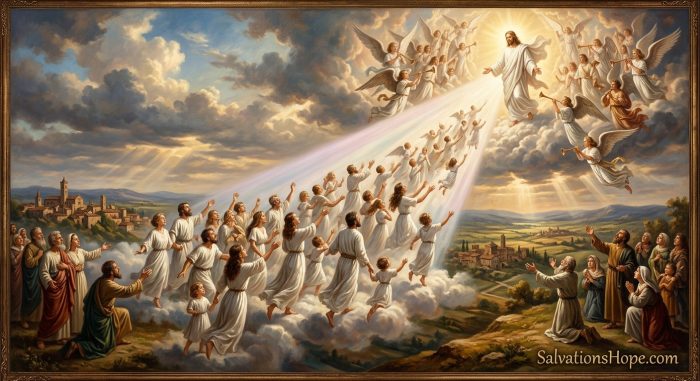
When Is The Rapture Going To Happen?
Navigating the Horizon
Why We Must Reject Date-Setting and Embrace the True Hope of Christ’s Return
The promise of Jesus Christ’s bodily return remains one of the most vital anchors of the Christian faith. It is a doctrine designed to inspire endurance, comfort the grieving, and cultivate holy living. Yet, across the centuries and particularly in the modern era, this glorious hope has frequently been eclipsed by an obsessive human fascination with chronologies, calendars, and decoding divine secrets.
The Legacy of Failed Predictions
Human attempts to pinpoint the exact timing of the Rapture or the Second Coming have a long, unblemished record of failure.
Every single attempt to map out a precise timetable for the end of the age has collapsed under the weight of its own hubris. For skeptics, these repeated embarrassments become an excuse to dismiss the return of Christ altogether as baseless mythology. However, orthodox believers understand a deeper truth: failed human predictions do not undermine the validity of Jesus’ words; they validate them.
The Divine Boundary: What Scripture Actually Teaches
Jesus Himself explicitly dismantled any notion that humanity could calculate His return. In the Gospels, He stated with absolute clarity that no human being—not even the angels in heaven—knows the day or the hour. Later, in the opening moments of the Acts of the Apostles, the resurrected Christ redirected His disciples away from calendar-making, noting that the Father keeps the times and epochs within His own sovereign authority.
"You also must be ready, because the Son of Man will come at an hour when you do not expect him." — Matthew 24:44
To assert a precise date for the Rapture is to implicitly claim that Jesus was either misinformed or deceptive. The unpredictability of the event is not an accidental oversight in the divine plan; it is a deliberate safeguard designed to keep every generation living in a state of active, dependent faithfulness.
The Danger of the Prophetic "Jigsaw Puzzle"
Beyond hard date-setting, another common pitfall involves constructing elaborate, blow-by-blow timelines of end-times events. This approach treats Holy Scripture like a coded puzzle box.
Living in the Light of the Promise
When we strip away sensationalist timelines and failed predictions, what remains is the pure, unadulterated call of the Gospel. The New Testament never urges believers to become amateur cryptographers or date-setters. Instead, it calls us to be watchful stewards, faithful servants, and bold witnesses.
The uncertainty of the hour is meant to keep our spiritual senses sharp. It prevents spiritual slumber, guards against complacency, and reminds us that our primary allegiance is to the King who is coming—not to the speculative calendars of man. Rather than looking to the horizon with anxious calculation, the Church looks upward with joyful anticipation, anchoring its daily work in the unchanging grace of God.
Navigating the Headlines
Why Sensationalist Eschatology Misses the Heart of Christ’s Return
Throughout the history of the modern church, a recurring phenomenon has captured the imagination of believers: the cottage industry of “prophecy experts” who specialize in mapping the symbolic language of biblical apocalyptic literature onto current geopolitical events.
From the shifting alignments of global superpowers to complex trade blocs and Middle Eastern political friction, every newspaper headline is treated as a secret code waiting to be cracked. In these frameworks, ancient symbols—such as the multi-headed beasts of Daniel and Revelation, obscure entities like Gog and Magog, and various horns and crowns—are routinely pressed into service to identify modern nations, international organizations, and contemporary political figures.
However, this approach to Scripture often reveals a fundamental misunderstanding of biblical genres, introduces dangerous spiritual distractions, and ultimately undermines the credibility of the Christian witness before a watching world.
The Flaw of "Newspaper Exegesis"
The core error of sensationalist eschatology is a method often called “newspaper exegesis”—reading the daily news into the text of Scripture rather than allowing Scripture to interpret its own historical and literary context.
Apocalyptic literature, such as the Book of Revelation or the Book of Daniel, is richly symbolic. Written primarily to encourage suffering and persecuted believers under oppressive regimes, these texts used vivid imagery—beasts, dragons, numbers, and cosmic disruptions—to communicate timeless theological truths: God is sovereign, earthly empires are temporary, and Christ ultimately triumphs over all evil.
When modern commentators strip these symbols of their original context to declare that a specific political union represents a prophetic beast, or that a particular modern nation fulfills an ancient military coalition, they commit several critical errors:
The Endless Cycle of Revision and Commercialization
Because global politics is inherently fluid, sensationalist prophecy charts have a remarkably short shelf life. Whenever the geopolitical landscape shifts—such as the unexpected conclusion of the Cold War or the emergence of new technological and economic superpowers—the entire predictive edifice is thrown into disarray.
Rather than recognizing that their interpretive grid was flawed from the start, modern “prophets of Armageddon” simply pivot. Old books are hastily pulled from shelves, new volumes are rushed to press, and updated video series are produced to fit the next crisis.
This perpetual cycle of rewriting timelines generates a lucrative revenue stream for religious marketers, but it comes at a steep spiritual cost. It turns the solemn, glorious hope of Christ’s return into a revolving-door commodity driven by fear, curiosity, and sensationalism.
The Spiritual Casualties: Distraction and Skepticism
The obsession with mapping current events to biblical end-times scenarios exacts a heavy toll on both the church and the culture:
“The constant stream of revised prophecy leaves Christians busy matching political events with biblical symbols rather than living right now as citizens of the Kingdom of God and getting ready to meet their King.”
A Theology of Watchful Readiness
Scripture does command believers to look forward to the return of Christ, but it frames this expectation entirely differently than modern sensationalism. Jesus explicitly told His disciples that it is not for them to know the times or epochs that the Father has fixed by His own authority (Acts 1:7).
Instead of turning the return of Christ into a complex puzzle to be solved by political analysts, the New Testament calls us to a posture of active, faithful watchfulness:
Ultimately, the goal of biblical prophecy is not to satisfy our curiosity about tomorrow’s headlines, but to anchor our hope in the unchanging character of God today.
Living in the Light of His Return
Understanding the Biblical Reality of the Rapture
In an age marked by cynicism and constant cultural noise, it is easy for the eternal promises of God to fade into the background. Perhaps you have encountered voices—or even felt the whisper in your own heart—suggesting that the promise of Christ’s return and the catching away of His church is merely a relic of religious mythology, an event that will never truly happen. Yet, Scripture calls us to a vastly different reality. While history is littered with the failed predictions of misguided date-setters who brought unnecessary disrepute to biblical prophecy, the promise itself remains immovable: Jesus Christ will surely come again, and His people will be gathered to meet Him.
God has not revealed the doctrine of the rapture to satisfy our intellectual curiosity or to fuel endless speculative timelines. Rather, divine revelation is given for spiritual transformation. The purpose of prophetic truth is not calculation, but consecration. Our proper posture is not one of frantic prediction, but of steadfast, daily preparation.
As our Lord Himself warned with crystal clarity:
“So you also must be ready, because the Son of Man will come at an hour when you do not expect him.” (Matthew 24:44)
The Two Ditches: Skepticism and Sensationalism
When it comes to the doctrine of Christ’s return, believers and seekers alike frequently veer into one of two spiritual hazards.
On one side of the road lies skepticism. This is the error of the mockers foretold by the apostles—those who look at the unbroken flow of human history and conclude that things will continue as they have since the beginning of creation. They dismiss the rapture as an imaginative flight of fancy, failing to reckon with the faithfulness of God’s word and the certainty of divine intervention.
On the other side of the road lies sensationalism. This is the error of treating biblical prophecy like a cryptographic puzzle to be solved for social media clout or best-selling books. Sensationalists let their imaginations run wild, weaving elaborate theories that eclipse the plain, sober teaching of Scripture.
To anchor our hearts safely between these two extremes, we must return to the text of Scripture. When we strip away cultural hype and cynical doubt, the Bible presents four defining characteristics of the rapture that should shape our daily walk with God.
Four Biblical Pillars of the Rapture
1. It Will Be Public
The rapture of the church is not a silent, secret vanishing act hidden away in the shadows of human history. The New Testament portrays an event accompanied by unmistakable, cosmic declarations. The Apostle Paul writes that the Lord Himself will descend from heaven with a loud command, with the voice of the archangel, and with the trumpet call of God (1 Thessalonians 4:16). While the world may misinterpret the moment or remain spiritually blind to its ultimate meaning, the event itself will pierce the veil of the physical universe with undeniable clarity.
2. It Will Be Overwhelming
Human vocabulary struggles to capture the sheer magnitude of the moment when mortality is swallowed up by immortality. It is an event of staggering glory, transforming the lowly bodies of believers to be like Christ’s glorious body. For the church, it is the ultimate expression of divine rescue and triumphant reunion. It will evoke profound awe, holy reverence, and overwhelming joy as the redeemed are ushered directly into the presence of their Savior.
3. It Will Be Sudden
The element of surprise is woven deeply into every biblical text addressing the parousia—the arrival of Christ. Scripture describes it as happening “in a moment, in the twinkling of an eye, at the last trumpet” (1 Corinthians 15:52). There will be no lingering countdown, no protracted warning period for the unrepentant to suddenly change their minds at the eleventh hour. It will interrupt ordinary routines—farming, working, sleeping—demonstrating that human history moves ultimately at the command of God, not the cadence of human progress.
4. It Will Be Final
The catching away of the saints marks a decisive turning point in redemptive history. It closes one epoch and opens another, serving as the bridge into the final realization of God’s kingdom. It reminds us that time is finite and that God’s patience, while vast, has an appointed goal. The finality of this event strips away our attachment to temporary earthly securities and fixes our gaze entirely upon things above.
From Speculation to Preparation
The appropriate response to the promise of the rapture is not a calendar, but a character. It is an invitation to examine our hearts, repent of lingering sin, and invest our energy into the work of the Kingdom.
When we live with the realistic, joyful expectation that Jesus could return at any moment, the priorities of our daily lives shift dramatically. Grudges soften, ambitions are sanctified, and our passion for sharing the Gospel is renewed. Let us put aside the distractions of speculation and embrace the holy calling of preparation, living each day fully awake, deeply faithful, and eagerly waiting for the blessed hope of His appearing.
The Manifest Glory of the King
Why the Return of Christ and the Rapture Will Be Public
Throughout the history of the Church, the return of Jesus Christ has remained the anchor of Christian hope. Believers across the centuries have looked forward to the day when history as we know it culminates in the physical, personal appearance of our Savior. Yet, in modern times, popular culture and specific theological systems have introduced a perspective that obscures this grand event: the notion of a “secret rapture,” where believers vanish quietly from the earth before a later, public return.
To understand the end times faithfully, we must turn away from modern fiction and return to the historic witness of Scripture. Far from being a stealthy, hidden disappearance, the biblical testimony points overwhelmingly to a universal, unmistakable, and glorious public manifestation.
The Cosmic Scope of Christ’s Return
When Jesus spoke about His second coming, He explicitly warned His disciples against rumors of hidden appearances and localized revelations. He knew that false teachers and self-proclaimed messiahs would arise, claiming secret knowledge or hidden corners where the Savior could be found.
Jesus countered these deceptions with a vivid comparison:
"If anyone says to you, 'Look, here is the Christ!' or 'There he is!' do not believe it... For as lightning that comes
from the east is visible even in the west, so will be the coming of the Son of Man." — Matthew 24:23, 27
Lightning does not whisper; it illuminates the entire night sky in a single flash. In the same way, the return of Christ will shatter the ordinary routines of the world with undeniable brilliance. Scripture emphasizes that His coming will feature a cosmic display of power and authority:
This is not a quiet footnote in history; it is a public coronation where every eye will see Him and every knee will bow.
Tracing the Origins of the "Secret Rapture"
Given the explicit nature of these passages, where did the idea of a secret rapture originate?
For the first eighteen centuries of Christian history, the universal consensus of the Church was that Christ would return once, publicly, to raise the dead, execute judgment, and renew creation. However, in the 1800s, a new hermeneutical framework known as dispensationalism emerged, heavily shaped by the teachings of John Nelson Darby and later popularized globally through the study notes of C.I. Scofield in his reference Bible.
This system introduced a multi-staged return: a secret, invisible rapture where believers are snatched away without the world noticing, followed years later by a public revelation. In the late 20th century, this framework captured the popular imagination through the best-selling Left Behind book and movie series.
While millions of sincere Christians hold to this view—anchored by a genuine, vibrant love for Jesus and an eager hope for His appearing—the concept itself finds no solid foundation in the text of the Bible. It is a theological novelty born in the 19th century, foreign to the ancient Christian creeds and the historic interpretation of the apostolic writings.
Exegesis of 1 Thessalonians 4: Noise, Glory, and Triumph
The primary biblical text used to support the concept of the rapture is found in the Apostle Paul’s first letter to the Thessalonians. Yet, a careful reading of the passage reveals an event characterized not by stealth and silence, but by overwhelming auditory and visual phenomena:
"For the Lord himself will come down from heaven, with a loud command, with the voice of the archangel and with the trumpet call of God, and the dead in Christ will rise first. After that, we who are still alive and are left will be caught up together with them in the clouds to meet the Lord in the air. And so we will be with the Lord forever." — 1 Thessalonians 4:16-17
Consider the sensory elements embedded in Paul’s description:
An event heralded by a divine shout, an angelic voice, and the trumpet call of God cannot, by any definition, remain hidden or secret. It is the ultimate public awakening.
The Historic Christian Hope
The historic Christian faith teaches that Christ will consummate history in one majestic, unified event. On that great day, the dead will rise, living believers will be transformed, and both groups will be caught up (the rapture) to meet their descending King in the air.
Rather than vanishing into a vacuum that puzzles secular society, this transformation and ascension will occur in full view of a watching world. The arrival of the King of Kings will bring final clarity: for those who have trusted in His grace, it will be the ultimate moment of redemption and unspeakable joy; for those who have hardened their hearts against Him, it will be the undeniable realization that the window of grace has closed and the King has arrived to judge the earth.
Ultimately, the rapture is not a secret escape hatch from human history, but the magnificent, public arrival of our Savior. It is a loud, visible, triumphant victory that reclaims the cosmos for its rightful Lord. Let us hold fast to this glorious hope, watching and waiting not for a hidden whisper, but for the brilliant flash of lightning that announces the return of our King.
The Overwhelming Triumph
Christ’s Return, the Post-Tribulation Gathering, and the Renewal of All Things
In the study of Christian eschatology, few themes capture the imagination and anchor the soul quite like the return of Jesus Christ. Far from an abstract theological concept, the second coming of our Lord stands as the definitive climax of redemptive history. Scripture presents this monumental event not as a quiet, secretive extraction of the church, but as an awe-inspiring, universally visible manifestation of divine sovereignty that completely overwhelms both the forces of darkness and the hearts of God’s people.
The Polarization of the Age: Darkness and Light at Their Peak
Bible scholars have long debated whether human society will experience moral elevation or catastrophic decline prior to the return of Christ. A careful synthesis of scriptural prophecy points to a profound paradox: the bad will keep getting worse, and the good will keep becoming better.
As the age draws to its close, God’s adversaries under the leadership of the Antichrist will reach the zenith of their cruelty and rebellion. The world will witness institutionalized oppression, systemic hostility toward the truth, and unprecedented horrors designed to eradicate the witness of the faithful. Yet, simultaneously, the grace of God will produce an extraordinary harvest of spiritual fortitude. Believers will display a depth of courage, love, and perseverance unseen in church history.
"And the gospel must first be preached to all nations. ... For then there will be great tribulation, such as
has not been since the beginning of the world until this time, no, nor ever shall be." (Matthew 13:10, 24:21)
Just as the global storm reaches its absolute breaking point—when the forces of evil believe they have successfully extinguished the light of the gospel—the King of kings will break through the cosmic veil.
The Grand Procession: Heaven Descending and Earth Rising
When Jesus returns, He will not come alone. His appearance will be accompanied by an overwhelming host of heavenly warriors:
This monumental transition is explicitly detailed by the Apostle Paul:
"Listen, I tell you a mystery: We will not all sleep, but we will all be changed—in a flash, in the twinkling of an eye, at the last trumpet.
For the trumpet will sound, the dead will be raised imperishable, and we will all be changed." (1 Corinthians 15:52)
In one miraculous moment, believers who were hunted, marginalized, and on the brink of destruction are entirely liberated. Freed not only from the tyranny of the Antichrist but even from the physical bonds of gravity, they ascend to meet their returning Lord in the air.
The Theology of the Meeting: Joy and Evacuation
Why do believers rise to meet Christ in the air rather than simply waiting for Him to touch down on solid ground? Christian theology and historical context reveal a two-fold purpose behind this breathtaking ascent: overwhelming joy and sovereign evacuation.
1. The Welcome of the King (Apantesis)
In the ancient Greco-Roman world, when a dignitary or king approached a city, the loyal citizens would practice a custom known as apantesis. They would rush outside the city gates to meet the arriving monarch, welcome him with great celebration, and escort him back into the city for the final stage of his arrival.
Believers do not ascend out of mere tactical necessity; they run upward because their hearts burn with love and loyalty for their Savior. Much like children rushing out the front door to embrace a returning parent, the redeemed of God are overcome with uncontainable joy. They meet the Lord in the air to accompany Him in triumphing over evil and establishing His righteous rule upon the earth.
2. Evacuation from Fiery Judgment
While the ascent of the saints is an act of joyful reception, it is simultaneously an act of divine rescue. The earth at the end of the age is subjected to the purging, fiery judgment of God. Scripture makes it clear that divine retribution must fall upon those who have rejected grace and oppressed the righteous:
"God is just: He will pay back trouble to those who trouble you and give relief to you who are troubled, and to us as well.
This will happen when the Lord Jesus is revealed from heaven in blazing fire with his powerful angels." (2 Thessalonians 1:6-8)
As the righteous are caught up to safety in glorified, indestructible bodies, the unrepentant face the catastrophic sweep of divine justice. This global judgment is not merely punitive; it is also profoundly cleansing.
Demolition and Rebuilding: The New Creation
The cosmic fire that accompanies Christ’s return serves as a divine reset, sweeping away the corruption of sin and clearing the slate for the ultimate renewal of the cosmos. As Peter writes:
"That day will bring about the destruction of the heavens by fire, and the elements will melt in the heat. But in keeping
with his promise we are looking forward to a new heaven and a new earth, where righteousness dwells." (2 Peter 3:12-13)
Before the meek can inherit the earth, the earth must be liberated from the curse of rebellion. The fire of judgment consumes the legacy of human wickedness, melting the contaminated elements of a fallen world.
Through this overwhelming display of power, justice, and grace, the people of God are preserved, vindicated, and glorified. They are swept up out of the line of fire not to escape history, but to return with Christ as co-heirs of a redeemed cosmos—the restored, vibrant home of righteousness where God dwells with His people forever.
Living in the Light of the Sudden Return of Christ
The Third Pillar of His Coming
The Christian hope is anchored in a breathtaking promise: Jesus Christ is returning. Within biblical eschatology, this event is characterized not merely as a distant historical marker, but as a dynamic, living reality that transforms how the believer navigates the present. As we explore the facets of Christ’s return, a third vital pillar emerges: His coming will be sudden.
Far from being a quiet, private event whispered away in a corner, the rapture will be public, cosmic, and overwhelming. Yet, regarding its timing, it will strike with absolute suddenness. If a heart is unanchored and a soul is spiritually asleep, the moment will catch them entirely unawares.
The Paradox of the "Thief in the Night"
To understand the suddenness of Christ’s return, Scripture employs the vivid imagery of a thief breaking into a house. Jesus Himself warns:
"Therefore keep watch, because you do not know on what day your Lord will come.
But understand this: If the owner of the house had known at what time of night the
thief was coming, he would have kept watch and would not have let his house be
broken into. So you also must be ready, because the Son of Man will come at an
hour when you do not expect him." — Matthew 24:42-44
It is crucial to clarify the metaphor. Jesus is not coming like a thief in His nature—He is not sneaking into the world to covertly steal away a secret treasure. The Bible repeatedly assures us that every eye will see Him, and His appearance will be accompanied by the sound of a trumpet and the shout of an archangel.
Rather, the comparison to a thief rests entirely upon unexpected timing. A thief arrives when security is lax and vigilance has failed. In the same way, the Lord’s descent will puncture the quiet routine of a world that has lulled itself into spiritual complacency.
The Ordinary Interrupted: The Great Separation
One of the most sobering aspects of Christ’s sudden return is the radical disruption it brings to everyday life. The world will be operating on its usual axis—commerce, labor, socialization, and ambition will be moving forward uninterrupted. People will be pursuing earthly security while ignoring the Savior.
Jesus paints a stark picture of this division:
In a single, unannounced moment, the invisible reality of the human heart becomes externally manifest. Those who have placed their trust in Christ will be instantly transformed and caught up to meet Him in the air, entering into eternal joy. Conversely, those who have resisted His grace will remain behind, facing a world stripped of its illusion of self-sufficiency, left to confront the reality of divine judgment.
Moving Past Date-Setting to Spiritual Readiness
Human curiosity has historically fixated on trying to decode the exact calendar of God’s redemptive timeline. However, Scripture consistently rebukes this impulse, shifting our focus from when He is coming to how we ought to live while we wait.
The Apostle Paul elaborates on this immediately after teaching about the gathering of believers in 1 Thessalonians 4:
"Now, brothers and sisters, about times and dates we do not need to write to you, for you know very well that
the day of the Lord will come like a thief in the night. While people are saying, 'Peace and safety,' destruction
will come on them suddenly, as labor pains on a pregnant woman, and they will not escape." — 1 Thessalonians 5:1-3
When society feels most secure—boasting in human progress, geopolitical treaties, or technological achievements—sudden judgment will break forth just like labor pains that cannot be stopped or delayed.
To illustrate the danger of presumption, Jesus tells the parable of the unfaithful servant in Matthew 24:48-51. The wicked servant looks at his master’s delayed physical presence and assumes he has time to indulge his fleshly desires, mistaking patience for absence. He begins to mistreat his peers and live in moral abandon. But the master returns on a day the servant least expects, bringing severe accountability.
A Call to Action: From Skepticism to Surrender
The suddenness of Christ’s return carries two very different implications depending on where one stands:
The call of the Gospel is not to panic, but to prepare. Because we do not know the hour, the only safe posture is a daily walk of faith, abiding in the grace of Christ, and living with eyes fixed on the eastern sky. Are you ready for the sudden trumpet call? If not today, the invitation remains open to turn from self-reliance, receive His forgiveness, and join the ranks of those who eagerly watch and wait for His appearing.
The Sudden, Public, and Final Return of Christ
The return of our Lord Jesus Christ is not a hidden event whispered in secret corners, nor is it a subject meant merely to satisfy theological curiosity or fuel speculative timelines. Scripture presents the Second Coming as an unmistakable, public, and overwhelming reality that will permanently alter human history. When Christ breaks through the clouds, His appearance will be as sudden as a flash of lightning stretching from east to west. It marks the absolute final chapter of the age of grace, bringing an irrevocable conclusion to human history as we know it.
The Biblical Parallel: The Closed Door of Noah’s Ark
To understand the gravity of Christ’s return, we must look to the pattern established in Scripture. Before the great flood, God demonstrated immense patience, granting humanity generations to repent under the ministry of Noah. Yet, a definitive boundary was established.
Just as the floodwaters caught an unprepared world unawares, so too will the Day of the Lord arrive like a thief in the night. There will be no second chances, no post-mortem extensions, and no tribulation-era redemptive do-overs.
The Sequence of the End Times and Final Judgment
Biblical eschatology points to a specific sequence of events culminating in the visible victory of God. The reign of the Antichrist and the fierce trials of the tribulation will transpire on earth before the gathering of the saints, as the forces of darkness mass together in a final attempt to eradicate faith.
Living Urgently in the Light of the Blessed Hope
Whether a person meets eternity through the appointment of physical death or through the sudden, glorious arrival of Christ, the theological reality remains unchanged: “Man is destined to die once, and after that to face judgment” (Hebrews 9:27). The door of opportunity closes permanently at the moment of death or at the moment of His return.
Prophecy is given to us by God not to map out every detail of tomorrow with intellectual pride, but to radically transform how we live today in holiness and devotion. Are you ready to meet Him?