
Inside the Scandalous World of the Herods
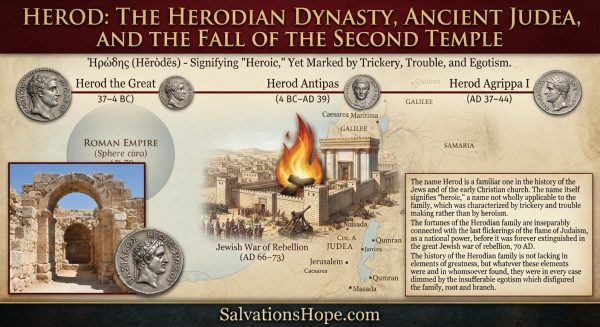
A Legacy of Talent and Tyranny
Mention the name Herod, and visions of ancient intrigue, ruthless ambition, and biblical drama instantly spring to mind. But the name itself—meaning "heroic"—could not be further from the truth.
Instead of heroism, the Herodian dynasty became synonymous with political trickery, royal paranoia, and staggering immorality. Their story is the dramatic final chapter of an independent Jewish nation, playing out right as Christianity was taking its first breath.
The fortunes of the Herodian family are inseparably linked to the last flickering's of Judaism as a national power, right up until its final, violent extinguishment in the Great Jewish War of 70 AD.
To be fair, the dynasty was not lacking in elements of capability. Several Herodian princes possessed undeniable political and administrative talents. However, whatever greatness they inherited was utterly dimmed by an insufferable egotism that corrupted the family root and branch.
The Backdrop to History
Despite their dark reputation, it was under the baleful, waning light of Herodian rule that Jesus of Nazareth lived and died, and it was beneath this volatile regime that the very foundations of the early Christian church were laid.
The Herods built magnificent monuments, manipulated Roman emperors, and held absolute terror over their subjects—yet they ultimately built a house of cards that collapsed under the weight of its own corruption.
What other figures from the tumultuous history of the ancient Near East would you like to explore next?
The Shadow of the Crown
The Tragedy and Legacy of the Herodian Dynasty
History is filled with powerful dynasties that shaped the ancient world, but few carry the dark, dramatic weight of the Herodian family. Talented, ambitious, and utterly compromised, the Herodian princes possessed gifts that could have uplifted a nation. Instead, their abilities were squandered on power struggles, leaving a legacy of devastation rather than progress for the people of Israel.
A Legacy of Intrigue and Isolation
To read the history of the house of Herod is to traverse a landscape of constant conflict. The family narrative was defined by:
For nearly all the kings of this ill-fated line, the verdict of history was written in the quiet indifference of their subjects. As the ancient observations note, at their deaths "they went without being desired"—unmissed and un-mourned by the very people they ruled. Their reigns were monuments to self-interest, completely detached from the well-being of the communities they controlled.
Dawn Amidst the Dusk
Yet, history operates in profound ironies. It was precisely under this baleful, waning light of Herodian rule that one of the most pivotal chapters in human history unfolded.
Amidst the corruption, political instability, and heavy-handed governance of the Herods, Jesus of Nazareth lived and died. In the deep shadows cast by this troubled dynasty, the quiet, enduring foundations of the Christian church were laid—proving that even the darkest historical epochs can give rise to an enduring dawn.
“In the baleful and waning light of the rule of the Herodians, Christ lived
and died, and under it the foundations of the Christian church were laid.”
What historical dynasty do you think presents the sharpest contrast between political darkness and cultural birth, much like the Herods and the rise of Christianity?
The Rise of the House of Herod
Ambition, Power, and Intrigue
For generations, the name Herod has been synonymous with ruthless authority and royal drama. But long before Herod the Great claimed his crown, the foundation of this remarkable dynasty was laid by men who possessed a rare blend of political cunning and opportunistic vision.
The story of the Herodian house is not one of ancient noble birth, but rather a masterclass in reading the shifting tides of geopolitics.
Roots in Idumea: A Question of Identity
Popular legend—actively promoted by Herod the Great himself—once claimed the family descended from an illustrious Babylonian Jew. History, however, tells a different story.
The Herodians were actually of Idumean stock. While the Idumeans had become nominal Jews following their forced conquest and mass circumcision by John Hyrcanus in 125 BC, deep national and cultural antagonisms lingered. They were outsiders ruling over a land that viewed them with suspicion.
The Architect of Ambition: Antipater
The true rise of the dynasty began with Antipas, who was appointed governor of Idumaea around 78 BC. Yet it was his son, Antipater, who inherited the full measure of ambition, resourcefulness, and political shrewdness that would later define his more famous son, Herod.
Antipater’s rise to power relied on a brilliant, calculating assessment of two major forces of the ancient world:
When a civil war erupted between the rival brothers Hyrcanus II and Aristobulus in 69 BC, Antipater craftily backed Hyrcanus—and convinced him to seek Roman intervention.
Playing the Roman Game
Antipater’s gamble paid off. He and Hyrcanus initially supported Pompey, but when Pompey fell, Antipater swiftly pivoted, leveraging the magnanimity of Julius Caesar after the Battle of Pharsalus in 48 BC.
His political agility earned him a massive reward: Antipater was named procurator of Judea in 47 BC, while his unwitting puppet, Hyrcanus, was left with the consolation prize of the high-priesthood.
Though Antipater’s life was cut short by an assassin’s blade in 43 BC, he left behind a formidable legacy through his children: Phasael, Joseph, Pheroras, Salome, and a second son destined to reshape history—Herod the Great.
A Legacy of Power and Family Strife
While Herod the Great ultimately thrust the family to the pinnacle of power and glory, the internal dynamics of the Herodian household were rarely peaceful.
Pheroras, serving nominally as a co-regent, inherited his father's cunning and managed to survive his famously cruel brother. Yet, both Pheroras and their sister Salome proved to be an endless source of turbulence, fueling continuous family brawls that plagued the dynasty from within.
Ultimately, the house of Herod was built on a foundation of sharp diplomacy, Roman patronage, and unrelenting ambition—a gripping saga of how a family of outsiders maneuvered their way to the absolute center of the ancient world.
The Paradox of Power
The Complex Legacy of Herod the Great
History remembers him as a tyrant wrapped in paranoia, a ruler whose name became synonymous with cruelty. Yet, stripped of the bloody lens through which posterity views him, Herod the Great was a man of staggering political genius, military prowess, and architectural vision. Had fate placed him in a different era or cast him in a different mold, he might well have lived up to the lofty title history granted him, rather than bearing it as a grim irony.
Our understanding of this towering, tragic figure is drawn primarily from the sweeping accounts of the ancient historian Josephus, alongside classical records from Strabo and Dio Cassius. To truly understand Herod, we must examine the three defining pillars of his life: his ruthless political maneuvering, his undeniable genius, and his deeply troubled domestic world.
The Rise of a Statesman: Political Activity
Herod’s ascent to power was forged in the crucible of a collapsing dynasty and shifting Roman loyalties. Born to ambition through his father, Antipater, Herod began his career as the governor of Galilee while still a young man. (While Josephus famously claimed he was a boy of fifteen, historians note this was a copyist's error; Herod was at least twenty-five, given that he lived to a ripe old age four decades later).Right away, Herod proved his mettle. He successfully cleared his domain of dangerous bands of freebooters and reliably delivered coveted tribute-money to Rome, earning the favor of the imperial court. By 41 BC, Mark Antony appointed him tetrarch of Judea.
However, power rarely comes easily. When the Parthians and the dying Asmonean house struck back, Herod’s brother Phasael died by suicide in prison, and his uncle Hyrcanus was mutilated to bar him from the priesthood. Undeterred, Herod fled to Rome. Backed by the unwavering favor of Antony and Augustus, he secured the crown of Judea in 37 BC—though he would have to carve out his kingdom with the sword.
Making quick work of the task, he captured Jerusalem by storm and immediately dismantled the ruling Asmonean bloodline. Yet, as Antony fell to Augustus at Actium in 31 BC, Herod’s masterclass in political survival took center stage. Through subtle flattery and decisive military support—such as wholly crushing the Arabians—Herod won the heart of the new Roman emperor, expanding his kingdom's borders in the process.
A Realm Divided: Talent vs. Tyranny
Herod’s administrative and military talent was undeniable, but his embrace of Roman culture created an unbridgeable chasm between himself and his Jewish subjects. Eager to modernize, he introduced Roman sports and heathen temples, alienating traditionalists and sparking the rise of the pro-Roman "Herodian party."
To appease the populace, Herod engaged in royal charity during times of famine, but the public saw him as a mere usurper propped up by foreign oppressors. Countless plots threatened his life, yet Herod defeated them all with near-superhuman cunning. He funded magnificent architecture and lavished gifts on Rome—at times even funding them by raiding the treasures of King David’s ancient tomb.
The Dark Interior: Character and Domestic Life
If Herod was a master of the geopolitical stage, his personal life was an unmitigated Greek tragedy. He was deeply ensnared by his own passions, often sacrificing the people he loved most on the altar of paranoia.
Driven by a relentless fear of rival claimants to his throne, he executed his beloved wife Mariamne I—the only human being he ever truly seemed to love—alongside her mother Alexandra. Years later, his suspicion consumed his own sons by Mariamne, Alexander and Aristobulus, whom he also ordered put to death.
As he aged, Herod fell victim to a terrible, incurable disease that left him in constant physical agony and amplified his erratic temper. Court intrigues and endless conspiracies marked his final days. In a final, desperate act of suffering, he attempted suicide. Even on the precipice of death, true to his tragic character, he ordered the execution of his treacherous son Antipater and plotted the mass execution of Jewish nobles to ensure mourning swept the nation when he finally drew his last breath. He died in the 37th year of his reign, leaving behind an epitaph penned by Josephus that cuts straight to the core of his legacy:
"A man he was of great barbarity toward all men equally, and a slave to his passions, but above the
consideration of what was right. Yet was he favored by fortune as much as any man ever was..."
The Architectural Mind
Reassessing the Complex Genius of Herod the Great
History often remembers figures by their darkest chapters, and few rulers carry a more troubled legacy than Herod the Great. Yet, looking past the political intrigue and the shadow of his darker impulses reveals a mind of extraordinary capability. Herod’s life was not a series of lucky breaks; it was a masterclass in statecraft, resilience, and, above all, monumental vision.
A Master of Statecraft and Survival
Born into a politically adept family, Herod inherited a sharp instinct for power. For an entire generation, he maintained control over a realm where, in many ways, his hand was against everyone and everyone’s hand was against him. His political survival relied on a rare mix of administrative genius and psychological insight:
Had his moral character matched his immense intellectual gifts, he might have left a legacy of unification rather than division. But his most defining talent lay elsewhere entirely.
The Builder King: A Pharaoh Reborn
Herod’s greatest passion was architecture, a drive that rivals the grand ambitions of the ancient Egyptian Pharaohs. His building campaigns transformed the physical landscape of the ancient world, though they often ignited deep cultural friction.
At Jerusalem, he pushed against the boundaries of orthodox Judaism by constructing a magnificent theater and amphitheater—introducing the frivolous, public-spirited culture of Greece and Rome into a traditionally ascetic society. To balance these controversial cultural moves and placate his subjects, Herod undertook his most breathtaking project: rebuilding the Temple.
A Wonder of the Ancient World
Undertaken between 19 BC and 11 or 9 BC, Herod's reconstruction of Zerubbabel's temple surpassed even the legendary scale of Solomon's temple. It was so transcendentally beautiful that it ranked among the wonders of the ancient world, sparking awe in historians like Josephus and prompting even the Roman general Titus to try and spare it during the final siege of Jerusalem.
Transforming the Landscape
Herod’s construction mania extended far beyond the capital. He reshaped cities across the region, blending utility with grandiose self-expression:
Ultimately, Herod’s monumental vision proved to be a double-edged sword. While his grand edifices permanently altered the architecture of the ancient Mediterranean, the universal scale of his operations—and his willingness to bend cultural norms—cemented the bitter alienation of his subjects. He remains a historical paradox: a brilliant statesman and visionary builder whose greatest achievements were forever shadowed by the deep divisions they created.
The Twisted Crown
The Complex Psychology and Bloody Domestic Life of Herod the Great
History remembers Herod the Great as a towering paradox—a brilliant statesman of immense physical and intellectual force whose name remains forever synonymous with tyranny and paranoia. Much like the Roman emperor Nero centuries later, Herod seemed to house two distinct individualities: one capable of grandeur and vision, and another driven by a darker nature that eventually consumed him entirely.
A Brilliant Mind Corrupted by Paranoia
In the opening years of his reign, Herod showed flashes of genuine greatness. He possessed an indomitable will, extraordinary tactical brilliance, and a commanding presence. He was never caught off-guard in a crisis, and cowardice was foreign to him.
However, the relentless pressures of his position—fueled by the endless whisperings of his court, the deep-seated resistance of the Jewish populace, and the heavy burden of his own transgressions—gradually warped his character. Consumed by the twin demons of jealousy and suspicion, Herod transformed into a ruthless despot who bathed his own palace in the blood of his family.
A Tangled Web of Domestic Misery
Herod’s private life was a tragic soap opera defined by broken laws, forbidden intermarriages, and staggering immorality. His family tree became a convoluted puzzle due to frequent marriages within the lines of prohibited consanguinity under Jewish law, further alienating him from his subjects. His romantic and familial relationships were marked by profound instability:
The inner workings of the Herodian court were so notorious that even Emperor Augustus in Rome reportedly quipped, “I would rather be Herod’s hog than his son.”
A Divided Kingdom and a Dark Legacy
When death finally approached, Herod attempted to set his affairs in order through a final testament ratified by Rome, dividing his territories among his surviving relatives:
Despite providing generously for his family in death, Herod passed away un-mourned and unloved by the people of Judea. Neither the mineral springs of Callirhoe could heal his decaying body, nor could the passage of time wash clean his bloody reputation.
For most modern readers, his legacy is crystallized in the biblical accounts of Matthew and Luke, where his desperate paranoia culminated in the infamous Massacre of the Innocents. Ironically, it is this dark historical footnote—alongside a lunar eclipse recorded by Josephus in 4 BC—that has given historians the crucial chronological markers needed to approximate the true date of the birth of Christ.
The Fox of Galilee
The Scandal, Scandalous Rise, and Fall of Herod Antipas
History remembers his father, Herod the Great, as a master builder and a ruthless tyrant. But the son who inherited a slice of that kingdom carved out a legacy of his own—one defined by political survival, scandalous romance, and a fateful collision with the dawn of Christianity.
Herod Antipas ruled as the tetrarch of Galilee and Peraea for over four decades, from 4 BC to 39 AD. Descended from Idumean and Samaritan roots, he had no claim to Jewish blood, making him an outsider ruling over a deeply religious land. Educated alongside the elite in Rome, Antipas absorbed the sophisticated tastes, administrative polish, and notorious vices of the imperial capital.
A Dynasty Built on Ambition and Brick
Like his father, Antipas possessed an insatiable architectural mania. He transformed the landscape of his territories, fortifying Sepphoris as his early capital and breathing new life into cities like Bethsaida and Betharamphtha, which he lavishly renamed Julia and Julias in honor of the Roman imperial family.
Yet, beneath the glittering facade of civic pride lay deep personal corruption. Described in the Gospels as "foxlike" in his cunning and deeply superstitious, Antipas's private life ultimately proved to be his undoing.
The Fatal Romance
Antipas’s downfall began with a web of illicit passion. Originally married to the daughter of King Aretas of Arabia, Antipas abandoned her after falling under the spell of Herodias—his own niece, who was already married to his half-brother, Philip.
This doubly incestuous union sent shockwaves through the region. King Aretas, deeply insulted by the rejection of his daughter, launched a devastating retaliatory war against Antipas. Meanwhile, the scandalous marriage drew fierce moral condemnation from the religious leaders of the day.
Chief among them was John the Baptist, who openly rebuked Antipas for violating Mosaic law. Driven by the manipulative influence of Herodias, Antipas had the prophet arrested and eventually executed—a dark stain on his reign that would haunt him for the rest of his days.
The Final Chapters: The Cross and Exile
Antipas’s path crossed with history one last time during the final hours of Jesus. When Pontius Pilate learned that Jesus was a Galilean, he sent the prisoner to Antipas, who happened to be in Jerusalem for the Passover. Eager for entertainment and entirely flippant, Antipas mocked Jesus before sending him back—an encounter that ironically forged a political alliance between the previously feuding Pilate and Antipas.
It was a brief reprieve. Blinded by ambition, Herodias eventually drove Antipas to travel to Rome to demand royal status from the Emperor Caligula. But betrayal awaited: their bitter enemy, Herod Agrippa I, intercepted the move with accusations of high treason.
Stripped of his power and wealth, the once-mighty tetrarch was banished to Lyons in Gaul, where he died in profound misery—a fitting end for a ruler consumed by his own cunning and vanity.
Did you know? Though Pilate and Herod Antipas became allies through the trial of Jesus, history notes that both men ultimately suffered the same fate: stripped of their authority and sent away to die in shameful exile.
What historical figure do you think had the most dramatic rise and fall in the ancient world?
The Quiet Ruler
Reconsidering Herod Philip
History is rarely kind to the Herodian dynasty. For generations, the name has been synonymous with ruthless ambition, political intrigue, and brutal tyranny. Yet, nestled within this infamous royal family was a figure who defied every expectation of his lineage: Herod Philip.
Often overshadowed by his more volatile brothers, Philip stands out in the historical record as an anomaly—a ruler defined by moderation, justice, and a quiet dignity that felt entirely out of place in the ancient Near East.
A Different Kind of Inheritance
Born to Herod the Great and his fifth wife, Cleopatra of Jerusalem, Philip’s path diverged from his siblings early on. When his powerful father died, the kingdom was fractured. Philip inherited the northeastern territories of Gaulonitis, Trachonitis, and Paneas.
While his brothers plotted, schemed, and fought for greater influence, Philip remained remarkably detached from the toxic undercurrents of the royal court. Historian Flavius Josephus paints a picture of a man who was:
Most historians attribute this un-Herodian disposition to his mother, Cleopatra of Jerusalem, whose quiet influence kept him grounded far away from the cutthroat politics of Jerusalem.
Legacy and Afterlife
Philip governed his tetrarchy peacefully until his death in 34 AD. Because he left no direct heirs, his territories were initially absorbed into the Roman province of Syria before being granted three years later to his nephew, Agrippa I.
Though he built no grand monuments to rival his father's architectural feats, Herod Philip left behind something far rarer for a ruler of his era: a legacy of quiet competence. In a family tree dominated by tyrants, Philip proved that power does not always have to corrupt.
The Brutal Reign of the Forgotten King
The Story of Herod Archelaus
History documents Herod the Great as a paranoid tyrant, but his eldest son, Herod Archelaus, carved out a legacy of cruelty all his own.
Inheriting a massive slice of his father’s kingdom—yet denied the royal crown—Archelaus ruled with a heavy, unyielding hand that pushed Judea and Samaria to the brink, ultimately sealing his own dramatic downfall.
A Volatile Upbringing
Born to Herod the Great and Malthace the Samaritan, Archelaus was educated alongside other Herodian princes in Rome. There, he became intimately familiar with the arbitrary, ruthless nature of the Roman imperial court—lessons he would later put to devastating use.
Even before taking power, palace intrigue swirled around him. His brother Antipater, plotting to clear his own path to the throne, accused Archelaus and his half-brother Philip of treason. Both were acquitted, but the experience foreshadowed the fierce family rivalries that would define his life.
Bloodshed and Succession
When Herod the Great died, his final will divided the kingdom. The lion’s share—including Judea, Samaria, and Idumea—fell to Archelaus, accompanied by the lesser title of "ethnarch" rather than king, pending Roman approval.
His brother, Herod Antipas, contested the will in Rome, while at home, Archelaus faced immediate revolt. In a brutal display of his father's temper, Archelaus forcibly crushed the rebellion, slaughtering 3,000 people in the process.
Despite fierce Jewish opposition and petitions sent to Rome, Emperor Augustus confirmed Archelaus's rule, though he conditioned the full royal title on the ethnarch's future good behavior.
Tyranny and Exile
Archelaus failed the test miserably. His governance of Judea and Samaria was characterized by relentless harshness and instability, plunging the region into chronic unrest.
In a rare twist of historical irony, the Jews and Samaritans—who harbored a bitter, historic hatred for one another—united in their misery. They dispatched a joint embassy to Rome to depose the tyrant. This time, their plea succeeded:
The Biblical Footnote
While history records his reign as a bloody chapter in the ancient Near East, his presence in sacred history is remarkably brief. The only mention of Archelaus in the New Testament appears in Matthew 2:22, where Joseph, returning from Egypt with Mary and the young Jesus, learns that Archelaus is reigning in Judea in place of his father Herod. Fearing for the child's safety, Joseph avoids the region and settles in Galilee instead.
Thus, the brief, volatile reign of Herod Archelaus quietly faded into history—remembered not for his palaces, but for the tyranny that drove an empire to banish him.
Note:
Of Herod, son of Herod the Great and Mariamne II (Simon's daughter) we know nothing except that he married Herodias, the daughter of his dead half-brother Aristobulus. He is called Philip in the New Testament (Matthew 14:3), and it was from him that Antipas lured Herodias away. His later history is wholly unknown, as well as that of Herod, the brother of Philip the tetrarch, and the oldest son of Herod the Great and Cleopatra of Jerusalem.
The Rise and Fall of Herod Agrippa I
The Last Great Ruler of a Turbulent Dynasty
History often pivots on ambition, survival, and unexpected alliances. Few figures embody this better than Herod Agrippa I, a master of political maneuvering who briefly restored the Herodian kingdom to its former glory before a sudden, dramatic downfall.
Descended from both the royal Herodian line and the ancient Asmonean (Maccabean) bloodline through his grandmother Mariamne I, Agrippa’s heritage was as prestigious as it was perilous. His grandfather, Herod the Great, had mercilessly pruned the family tree out of fear of rival claims. Yet, from that nearly extinguished line, Agrippa emerged to claim the ultimate prize.
A Dangerous Education and Imperial Friendships
Educated in Rome alongside the future emperor Claudius, Agrippa developed a sharp shrewdness and deep political tact. After a brief return to Judea, he headed back to Rome in 37 AD, determined to elevate his standing.
He formed a crucial bond with Caius Caligula, the heir presumptive to the Roman throne. Agrippa’s vocal support for Caligula even landed him briefly in prison under the paranoid Emperor Tiberius. Far from ruining him, however, this loyalty was the making of his fortune.
When Caligula finally ascended the throne, he immediately freed Agrippa, transforming him from a private citizen into a king by granting him the northern territories of Philip and Lysanias.
Rebuilding the Kingdom
Agrippa’s ambition didn't stop there. Capitalizing on the missteps of his rival uncle, Herod Antipas, Agrippa helped orchestrate Antipas's exile, securing Galilee and Peraea in 39 AD as a reward.
His crowning political moment came after Caligula’s assassination. With the imperial crown offered to the hesitant Claudius, it was Agrippa who stepped in as a power broker, guiding Claudius to accept the throne. Impressed by his loyalty, Claudius rewarded Agrippa by adding Judea and Samaria to his domain in 40 AD. At last, the dreams of Agrippa were realized: the old Herodian power had been restored to the exact boundaries of Herod the Great.
Navigating Faith and Politics in Judea
As ruler, Agrippa proved remarkably adept at balancing Roman loyalty with local Jewish sensitivities. Knowing the immense religious friction it would cause, he successfully persuaded Caligula to abandon plans to erect an imperial statue inside Jerusalem.
However, when forced to navigate the rising tension between traditional Judaism and the nascent Christian movement, Agrippa chose a decidedly aggressive path. Eager to win favor with local religious leaders, he became a fierce persecutor of the early church, executing the apostle James with the sword, as detailed in the biblical book of Acts.
A Sudden End and a Complex Legacy
Agrippa's reign at the pinnacle of power was short-lived. He died suddenly in the full flush of his authority, struck down by a harrowing illness reminiscent of the grim fate of his grandfather. He left behind four children, three of whom left heavy footprints in history:
With the death of Herod Agrippa I, the grand illusion of an independent Herodian empire effectively ran its course, leaving behind a legacy of high-stakes politics, dramatic ambition, and profound historical consequence.
The Last Crown of Judea
The Complex Legacy of Herod Agrippa II
History often paints the Herodian dynasty with a broad brush—foreign-backed rulers whose grand architectural tastes matched a cold disdain for the Jewish subjects they governed. Yet, the final king to bear the name, Herod Agrippa II, stood as a fascinating exception. Reared in the halls of imperial Rome, he nevertheless retained a profound connection to his ancestral roots, navigating a treacherous path between Roman loyalty and Jewish nationalism until the bitter end.
A Roman Education and a Jewish Heart
Born around 27 AD to Herod Agrippa I, the young prince was just 17 when his father died. Emperor Claudius deemed him too young to inherit Judea directly, placing the region under a Roman procurator instead.
Agrippa had been raised in the imperial palace in Rome, receiving a premier royal education. However, he never forgot his people. Early in his career, he successfully interceded with Rome on behalf of the Jews, securing their right to custody of the official high priestly robes. Gradually, Rome expanded his authority:
Unlike his predecessors, Agrippa possessed a genuine warmth toward the Jewish population. While he shared the classic Herodian love for grand architecture, he lacked the icy detachment that typically defined the dynasty. Quite simply, the Agrippas considered themselves Jews.
In the Biblical Spotlight: Paul and Bernice
Readers of the New Testament encounter Herod Agrippa II in the dramatic courtroom scenes of Acts 25 and 26. When the Apostle Paul was brought before Roman authorities, he specifically appealed to Agrippa, recognizing the king's deep familiarity with Jewish customs and the Scriptures.
Visiting as a favored guest alongside his sister and brother-in-law, the Roman governor Felix, Agrippa listened intently to Paul's testimony. Yet, Agrippa’s personal life was also a source of intense public scrutiny. His close relationship with his sister, Bernice, sparked widespread scandal among both Jews and Gentiles alike.
The Fall of a Nation and the Last Days of a King
As tensions mounted in the lead-up to the Great Jewish Revolt, Agrippa recognized the utter futility of warring against the superpower of Rome. He delivered a famous, impassioned oration begging the people not to rebel—a speech recorded by historians as a masterpiece of persuasion.
When his warnings went unheeded, Agrippa made his choice. He boldly sided with Rome, fighting under its banners and even taking a sling-stone wound to the leg during the brutal siege of Gamala.
When the inevitable collapse of the Jewish nation arrived, Agrippa’s kingdom fell alongside it. In recognition of his unwavering loyalty, Rome welcomed him with open arms. Agrippa and Bernice relocated to Rome, where he served as a praetor. He lived to the age of 70, passing away in 100 AD at the dawn of the reign of Emperor Trajan—closing the final chapter on the Herodian royal line."
The Agrippas were Jews." — Josephus on the unique cultural alignment of the final Herodian monarchs.
How do you view rulers who walk the tightrope between an occupying empire and their native people—as pragmatic survivors, or tragic figures caught between two worlds?