
The Trap of Self-Sufficiency
The Global Mirror
Redefining Rich
In the modern digital age, information flows seamlessly across borders, yet a profound distortion often clouds our perception of wealth. When Americans think of financial struggle, they measure it against domestic benchmarks: inflation, housing costs, student loans, and retirement savings. Yet, when viewed through a global lens, the financial reality of everyday life in the United States looks drastically different.
To understand what the Bible truly teaches about wealth, possessions, and the Kingdom of God, we must first confront a humbling statistical reality: by global standards, the vast majority of people living in America are among the wealthiest individuals on the planet. While workers in developing, third-world nations may labor long hours for a fraction of a living wage—often surviving on just a few dollars a day—even a modest American income places an individual comfortably within the global top ten percent.
When we examine the global economic landscape, the disparity is striking. While the median American enjoys an income and standard of living that places them among the wealthiest tier of humanity, billions of people in developing nations survive on extreme budgets of less than $1,000 a year. For the believer, this vast economic gap is not just a political or sociological topic—it is a profound spiritual mirror that calls us to examine our hearts and our responsibilities.
The Encounter with the Rich Young Ruler (Matthew 19:16–30)
16 And, behold, one came and said unto him, Good Master, what good thing shall I do, that I may have eternal life? 17 And he said unto him, Why callest thou me good? there is none good but one, that is, God: but if thou wilt enter into life, keep the commandments. 18 He saith unto him, Which? Jesus said, Thou shalt do no murder, Thou shalt not commit adultery, Thou shalt not steal, Thou shalt not bear false witness, 19 Honour thy father and thy mother: and, Thou shalt love thy neighbour as thyself. 20 The young man saith unto him, All these things have I kept from my youth up: what lack I yet? 21 Jesus said unto him, If thou wilt be perfect, go and sell that thou hast, and give to the poor, and thou shalt have treasure in heaven: and come and follow me. 22 But when the young man heard that saying, he went away sorrowful: for he had great possessions. 23 Then said Jesus unto his disciples, Verily I say unto you, That a rich man shall hardly enter into the kingdom of heaven. 24 And again I say unto you, It is easier for a camel to go through the eye of a needle, than for a rich man to enter into the kingdom of God.
The Global Contrast: Seeing Our Wealth Through Kingdom Eyes
To properly grasp Jesus’ warning to the rich young ruler, we must shed our localized definitions of being “rich.” In the United States, a household earning a median income feels the squeeze of daily expenses, taxes, and consumer debt. We often look upward at the ultra-wealthy billionaires and assume we are safely in the middle or struggling.
However, when compared to the developing world—where billions of people live on less than a few dollars a day—the average American lifestyle is characterized by unprecedented abundance. We have constant access to clean water, electricity, technological infrastructure, diverse food supplies, and social safety nets.
When we read Matthew 19 as affluent Westerners, we are the rich young ruler and just like the young man in the passage, we often check all the moral boxes:
- We attend church services and try to live upright lives.
- We pay our taxes, avoid major crimes, and care for our immediate families.
- We look at our standard of living and ask, "What lack I yet?"
The Trap of "Great Possessions"
Jesus’ command to the young ruler—to sell all he had, give to the poor, and follow Him—sent the man away sorrowful because his identity and security were anchored in his wealth.
Wealth in America is rarely viewed just as money; it is viewed as security, independence, and status. The more we earn, the more our standard of living expands to consume it, creating a perpetual cycle of perceived need. This accumulation creates a spiritual blind spot. It is remarkably easy to substitute financial self-sufficiency for absolute dependence on God.
When Jesus uses the striking hyperbole of a camel passing through the eye of a needle (v. 24), He is confronting the inherent spiritual hazard of wealth: it is difficult for those who possess security in earthly systems to feel their urgent need for a Savior.
Rethinking "Normal": Who Is Really Weird?
Consider the global Church. If you live in the West, you might subconsciously picture church leadership shaped entirely by your local culture. Yet, movements like the explosive growth of the church in China remind us that Western affluence and religious ease are historically rare.
- The global majority lives on a fraction of Western income.
- If you own a personal computer and a reliable internet connection, you belong to a microscopic global elite.
- Out of 100 people globally, only a tiny handful enjoy the daily material abundance we often take for granted.
A Wake-Up Call for Modern Believers
When Jesus addressed the ancient church of Laodicea, He spoke to a culture of wealth and self-reliance that had grown spiritually complacent. Today, that exact warning echoes loudly across the Western world. Below is a contemporary Bible teaching framing Revelation 3 as a direct letter to the modern church in America. This is not a way to try to change Scripture it is only applying Scripture to the church in America today.
An Open Letter to the Church in America
“To the church in America, the land of comfort, abundance, and technological advancement, these are the words of the Amen, the faithful and true witness, the ruler of God’s creation: I know your deeds. You are neither spiritually freezing nor spiritually on fire. You blend in with the culture, keeping your faith private and convenient. I wish you were either one or the other! But because you are lukewarm—satisfied with a domesticated, consumer-driven religion—I am about to spit you out of My mouth. You say, ‘We are rich, we have acquired massive ministries, high-tech sanctuaries, and cultural influence, and we do not lack a thing.’ But you do not realize that spiritually, you are wretched, pitiful, poor, blind, and naked. I counsel you to buy from Me gold refined in the fire so you can become truly rich; white clothes of righteousness to cover your compromises; and spiritual eye salve so you can see your true condition. Those whom I love I rebuke and discipline. So be earnest and repent. Here I am! I stand at the door of your institutions and your hearts and I knock. If anyone hears My voice and opens the door, I will come in and fellowship with them. To the one who overcomes, I will give the right to sit with Me on My throne… Whoever has ears, let them hear what the Spirit says to the churches.”
3 Vital Takeaways for Today's Believer
- The Danger of Material Comfort: Financial prosperity and cultural safety can subtly replace our absolute dependence on God, masking deep spiritual poverty with outward success.
- The Sickness of Acknowledged Apathy: A "lukewarm" faith tries to balance the Kingdom of God with the values of the world, offering a compromise that Christ rejects entirely.
- The Open Door of Grace: Jesus' correction is not meant to condemn, but to invite us back into intimate, life-changing communion with Him.
How can you personally evaluate whether your daily spiritual life is marked by genuine zeal or cultural complacency?
Awakening from Spiritual Apathy
A Hard Look at Lukewarm Christianity
When we read the letters to the early churches in Scripture, it is easy to get bogged down in historical timelines and geographical trivia. But sometimes, diving too deep into the background causes us to miss the piercing, direct point the Spirit is trying to make.
Consider the message to the church in Laodicea (Revelation 3:15–16). Jesus doesn’t offer a complex theological puzzle; His message is stark, uncomfortable, and intensely personal.
The Danger of the "Lukewarm" Life
So, because you are lukewarm—neither hot nor cold—I am about to spit you out of my mouth.” — Revelation 3:15–16
Jesus uses a vivid, visceral metaphor. Think about how you feel when you accidentally take a sip of lukewarm coffee or flat, room-temperature soda. It’s unappealing—it makes you gag.
That is how Jesus describes a casual, half-hearted approach to faith. These believers weren’t outright hostile atheists; they were just indifferent. They weren’t “on fire” for God. Their spiritual temperature was stuck in the middle, and Christ says that state of apathy is repulsive to Him.
The Trap of Self-Sufficiency and Material Wealth
Why did this church drift into such deep spiritual apathy? The answer is found in the very next verse:
But you do not realize that you are wretched, pitiful, poor, blind and naked.” — Revelation 3:17
Material comfort and financial security breed a dangerous illusion: the belief that we don’t need God.
- When your retirement is fully funded...
- When your fridge is stocked...
- When your home is safe and comfortable...
…it becomes very easy to stop praying for “daily bread.” We build a life of total self-reliance. We look at our security and think we’re doing fine. But from heaven’s perspective, spiritual wealth and material comfort are often inversely related. While the Laodiceans felt rich, God looked at them and saw spiritual bankruptcy.
The Tragedy of Wanting to Be Lukewarm
The scariest part of spiritual complacency isn’t just sliding into it—it’s getting comfortable there. Many people treat God like an insurance policy or an optional lifestyle accessory. They want a “little bit” of God:
- Just enough to give the kids some good morals.
- Just enough to feel like a good person on the weekends.
- Just enough to ease the conscience, but not enough to disrupt career ambitions, bank accounts, or personal comfort.
They have just enough of God to feel safe, but not enough to actually surrender. They don’t want to be on fire because being on fire requires sacrifice. They prefer the safety of the middle ground, and they actively resist anyone who challenges them to go deeper.
Comparing Earthly Junk to Infinite Treasure
The Kingdom of Heaven is supposed to be like finding a buried treasure so valuable that a person gladly sells everything they own just to possess it (Matthew 13:44).
Yet, when we are lukewarm, we look at the Creator of the universe—the One who spoke galaxies into existence—and weigh Him against a comfortable house, a nice car, or a few easy years of retirement. We hesitate to give up our temporary, earthly routines for an eternal God. That hesitation is what breaks the heart of Christ. We trade infinite grace for temporary dirt.
God’s Discipline is an Act of Love
Why does Jesus use such harsh, uncompromising language? Is it to condemn us, or is it a wake-up call?
“Those whom I love I rebuke and discipline. So be earnest and repent.” — Revelation 3:19
His words are severe because His love is fierce. He doesn’t want anyone to drift blindly into eternal ruin while playing church. His discipline and conviction are designed to shake us out of our “Disneyland” bubbles of comfort.
If you recognize that your spiritual life has grown cold or casual, do not just read this and walk away unchanged. Don’t let spiritual numbness keep you locked in place. Examine your heart, strip away the false securities of this world, and fall on your knees in desperate prayer:
“Lord, don’t let me end my life lukewarm. Set my heart on fire for You again.”
The Trap of Comfort
What Jesus Really Meant About Wealth and the Kingdom
If you have studied the Gospels for any length of time, certain passages start to feel overly familiar. We dissect them, wrap theological explanations around them, and sometimes completely miss the plain, uncomfortable truth sitting right in front of us.
Take Jesus’ famous words about a camel passing through the eye of a needle compared to a rich person entering the kingdom of God. After decades of looking at this passage, the reality of what Jesus is saying comes down to a blunt statement: It is humanly impossible.
The Humanly Impossible Standard
When Jesus looked at the rich young ruler, He wasn’t just giving a localized moral lesson; He was exposing a fundamental human illusion. Wealth creates a false sense of security. When you are rich and comfortable, you naturally start to think your riches are actually worth something eternally—and worse, you stop feeling needy.
- The Human Level: On our own strength, with our own self-reliance and material security, entering the kingdom of God is impossible.
- The Divine Level: "With man this is impossible, but with God all things are possible." (Matthew 19:26)
Salvation isn’t something we can buy, budget, or earn. It takes a miraculous, divine intervention to break through the armor of human comfort.
Zacchaeus: The Joy of Finding the Ultimate Treasure
Just a few chapters later, Luke gives us a front-row seat to the “impossible” becoming a reality. Enter Zacchaeus—a wealthy chief tax collector who was despised by his community.
When Jesus calls him down from the sycamore tree and invites Himself to dinner, something incredible happens. Zacchaeus doesn’t hesitate, and he doesn’t calculate his losses out of reluctant guilt. He stands up and declares:
cheated anybody out of anything, I will pay back four times the amount.” (Luke 19:8)
Why did he do it? Because he realized he had found the ultimate treasure. Think about the parable of the hidden treasure in a field: a man finds it, covers it back up, and with great joy sells everything he owns just to buy that field. Zacchaeus didn’t climb down that tree groaning about how much money he was losing. He threw his wealth away with joy because Jesus was standing right there. He found a treasure so much greater than his bank account that his money instantly lost its grip on him.
The Blind Spot of Affluence
We often use the phrase, “Money does weird things to people.” Notice the pronoun we use: people. We always point the finger outward. We talk about how money corrupts someone else, how wealth makes them weird, or how other people are blinded by materialism. Have you ever heard someone honestly say, “Money has done very weird things to me”? The danger of wealth is that it tricks us into feeling safe. The more financial padding we have, the less inclined we are to believe we are spiritually needy. It builds a quiet, invisible barrier between our hearts and our absolute dependence on God.
A Modern Mirror: The Church of Laodicea
This isn’t just an ancient problem; it is a modern mirror. In Revelation 3, Jesus writes seven letters to seven churches. One of them—the church in Laodicea—was remarkably wealthy and self-sufficient.
But you do not realize that you are wretched, pitiful, poor, blind and naked.” (Revelation 3:17)
Jesus’ warning to Laodicea is stark and unsettling. Their physical comfort completely blinded them to their spiritual poverty, leading to that chilling phrase: “So, because you are lukewarm—neither hot nor cold—I am about to spit you out of my mouth.” (Revelation 3:16)
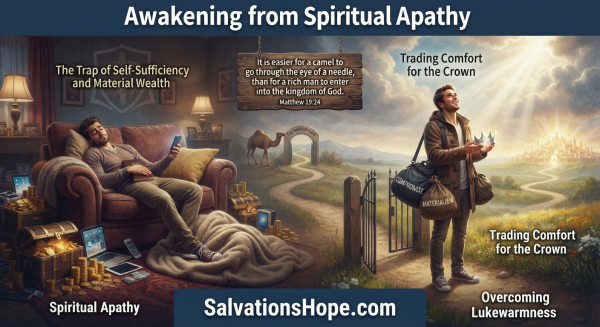
Trading Comfort for the Crown
Overcoming Lukewarmness and Seeing True Riches
In our modern culture, safety, financial security, and comfort are often the ultimate goals. We build secure lives, settle into prosperous neighborhoods, and surround ourselves with stability. But spiritually speaking, comfort can be one of the most dangerous traps we face.
When life is comfortable, it is easy to slip into spiritual apathy—to become lukewarm. But how much are our earthly securities costing us spiritually? Let’s dive into a sobering, passionate look at what it truly means to overcome complacency and fix our eyes on the ultimate treasure: Jesus Christ.
The Sickness of Comfort and Security
It is easy to look around at a safe, affluent environment and think, “I want to be the example of someone who lives in this crazy, rich, safe environment and still doesn’t care about security—someone whose eyes are completely fixed on God.” But let’s be honest: that is an incredibly difficult posture to maintain. The heavy pull of wealth, ease, and self-preservation clouds our vision.
Think of it like a struggling addict trying to break a habit. If someone is fighting alcoholism, wisdom dictates that they step away from the bar because they aren’t strong enough to handle the temptation. In the same way, we can suffer from a spiritual sickness called comfort and security. If our environment, our riches, or our obsession with safety pulls our hearts away from God, we have to evaluate whether we are playing with fire. Spiritual survival requires radical honesty. Are we willing to prioritize our eternal salvation over temporary earthly ease?
The Invitation of the Knocking Savior
In Revelation 3:20–21, Jesus issues a personal, urgent invitation:
“Here I am! I stand at the door and knock. If anyone hears my voice and opens the door, I will come in and eat with that person, and they with me. To the one who overcomes, I will give the right to sit with me on my throne, just as I overcame and sat down with my Father on his throne.”
Jesus isn’t knocking to condemn; He is knocking because He loves us. He knows that our pursuit of worldly things makes us spiritually “sick,” and He wants to save us from being spit out of His mouth. He is offering something infinitely better: true riches.
The Bible speaks of a broad, easy road of luke-warmness that leads to destruction, where everyone else is drifting with the cultural current. But there is also a narrow road. The overcomers are the ones who look past the fleeting treasures of this world, see Jesus, and swim against the current.
A Glimpse of the Throne (Revelation 4)
Why are overcomers willing to let go of everything else? Because of what they see next. In Revelation 4, the Apostle John looks up through an open door in heaven and beholds the raw majesty of God:
- A throne surrounded by lightning, pillars of fire, and a sea of glass.
- The Creator glowing like brilliant diamonds and rubies.
- Twenty-four elders bowing and casting their crowns before Him.
- Four living creatures crying out unceasingly, "Holy, holy, holy."
- A hundred million angels worshiping in absolute surrender.
Jesus makes an astounding promise: If you overcome, you can sit on that throne with Him. When you truly catch a vision of the throne room of God, everything this little world has to offer suddenly looks trivial. Television magazines and prosperity teachers might tell you that God wants you to be rich down here, but when you possess God, you won’t even care about earthly riches. They pale in comparison to His glory.
The Radical, Dangerous Prayer
So, how do we escape the trap of luke-warmness? It requires more than casual church attendance or a half-hearted prayer life. It demands total surrender. Take a moment to step away from distractions, quiet your heart, and bring these hard questions before God:
- Reveal My Lukewarmness: "God, show me the areas of my life where I am lukewarm and comfortable."
- Grant Me Strength: "Give me strength in the areas where I am weak and easily distracted by this world."
- Do Whatever It Takes: "God, am I willing to let you do whatever it takes to set me on fire for you? If you need to strip away my comfort, my possessions, or anything holding me back—please do it, because I want you more than anything else."
Reorienting Our Wealth Toward Eternity
The disciples’ reaction—“Who then can be saved?”—reveals that wealth was historically viewed as a sign of divine favor. If the rich cannot easily enter the kingdom, who can? Jesus answers with a profound gospel truth: “With men this is impossible; but with God all things are possible.”
Salvation cannot be bought, nor can it be blocked permanently by material blessings, provided our hearts are surrendered. For the believer living in a wealthy nation like America, this passage demands a radical realignment:
- Acknowledge Global Stewardship: Recognize that the income earned in America is not merely a product of personal merit, but a position of profound global stewardship. God has entrusted surplus resources into our hands for a purpose.
- Combating Materialism: Guard against the cultural pressure to hoard, upgrade, and consume. True contentment is found not in accumulating possessions, but in radical generosity toward the poor and vulnerable worldwide.
- Investing in Eternal Treasure: As Jesus promised Peter in verses 28–29, sacrifices made for His name’s sake—whether financial, relational, or material—are met with an eternal reward that completely eclipses anything earth can offer.
Practical Steps for a Global Kingdom Mindset
- Examine your assumptions: Recognize that your daily standard of living is a profound luxury, not the global baseline.
- Pray globally: Intercede regularly for the persecuted and underground churches, especially in regions experiencing massive spiritual revival.
- Practice radical gratitude: Thank God daily for resources many of our global family members live without.
Reflecting on Your Walk
Wealth and comfort aren’t inherently evil, but they demand rigorous spiritual honesty. When we look at our own lives, possessions, and safety nets, we have to ask ourselves: Are we relying on the temporary security of this world, or are we joyfully holding our earthly treasures loosely compared to the infinite value of Christ?
Where do you find yourself most tempted to trust in material comfort rather than leaning completely on God’s daily provision?