
Wolf Among The Sheep
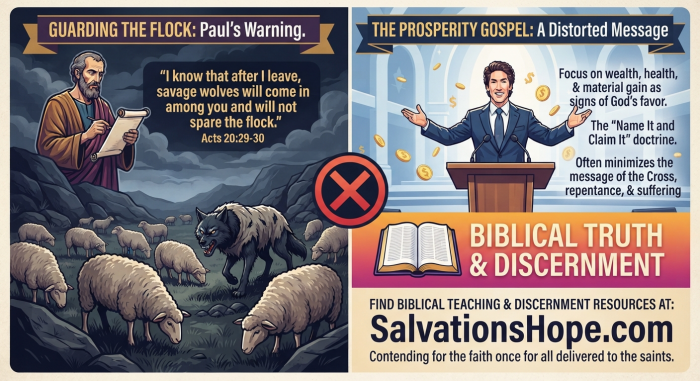
Guarding the Flock in an Age of Tickling Ears
The Final Words from a Dark Cell
Picture a cold, damp, subterranean Roman dungeon—the Mamertine Prison. The stone walls are slick with moisture, the air is heavy with the scent of suffering, and a lone iron chain binds an aging apostle to the floor. The Apostle Paul knows his earthly race is run. His physical body is broken, worn out by decades of shipwrecks, beatings, stoning’s, and relentless labor for the name of Christ Jesus.
Yet, as he dictates his final earthly letter to his beloved spiritual son, Timothy, his mind is not consumed by self-pity or fear of the executioner’s blade. Instead, his heart beats with an urgent, blazing passion for the purity of the Church of Jesus Christ. He looks past his own chains, peering across the generations into our exact cultural moment, and issues a solemn, timeless charge that echoes down through the corridors of time:
“I charge you in the presence of God and of Christ Jesus, who is to judge the living and the dead, and by his appearing and his kingdom: preach the word; be ready in season and out of season; reprove, rebuke, and exhort, with complete patience and teaching.” (2 Timothy 4:1–2)
Paul’s commission to Timothy is not a localized, temporary suggestion for a young pastor in Ephesus; it is the permanent, non-negotiable marching order for every faithful minister of the gospel in every age, every place, and every circumstance.
The Anatomy of Spiritual Deception: Itching Ears and Modern Myths
Paul’s urgency stems from a sobering prophetic reality. He warns Timothy of a psychological and spiritual epidemic that would inevitably plague the church:
“For the time is coming when people will not endure sound teaching, but having itching ears they will accumulate for themselves teachers to suit their own passions, and will turn away from listening to the truth and wander off into myths.” (2 Timothy 4:3–4)
Notice the precise mechanics of this spiritual decay. People do not accidentally stumble away from the truth; they actively accumulate teachers who validate their fleshly desires. An “itching ear” is a symptom of a heart that desires comfort over conviction, affirmation over repentance, and a customized spirituality over the unvarnished claims of the cross.
When congregations demand a message that centers on human potential, self-actualization, and material gratification, the spiritual market responds. False teachers emerge not merely as external persecutors, but as internal parasites. As Paul warned the Ephesian Elders.
“I know that after my departure fierce wolves will come in among you, not sparing the flock; and from among your own selves will arise men speaking twisted things, to draw away the disciples after them.” (Acts 20:29–30:)
This warning exposes a terrifying truth: the greatest danger to the modern church is not necessarily the militant atheist outside its doors, but the polished purveyor of counterfeit grace sitting comfortably inside the pulpit, whispering what human ears long to hear.
The Great Reversal: Understanding Christ’s True Riches
To understand how far modern religious culture has drifted, we must look to the historic pillars of the Christian faith. In 1867, the Prince of Preachers, Charles Spurgeon, stood before a massive congregation in London and delivered a searing critique of the human obsession with wealth, contrasting it sharply with the staggering self-emptying of our Lord.
Spurgeon reflected on 2 Corinthians 8:9: “For you know the grace of our Lord Jesus Christ, that though he was rich, yet for your sake he became poor, so that you by his poverty might become rich.”
Spurgeon masterfully unpacked the immeasurable wealth of Christ prior to the Incarnation:
- Rich in Possession: As the Creator of all things, the cattle on a thousand hills, the secret treasuries of silver, the blazing stars, and the vast expanses of the cosmos were His by absolute right.
- Rich in Service: Legions of unfallen angels stood at His gates, crying out day and night in holy adoration, ready to fly upon His every command.
- Rich in Honor: He sat co-equal and co-eternal with the Father, enveloped in unapproachable light, receiving the perpetual, unbroken symphonies of heaven.
- Rich in Love: He basked in the eternal, perfect affection of the Father.
Yet, what did Christ do? He laid it all down. He exchanged the throne of absolute glory for a borrowed manger, the adoration of angels for the spittle of rebellious men, the golden streets for the blood-stained wood of Calvary.
Spurgeon boldly challenged the materialistic mindset of his own day—a mindset that has metastasized into an epidemic today:
There are thousands of men and women with whom that is the only thing they are living for—to save, save,
save—and make a fortune! And when they die, what then?”
True Christianity does not baptize human greed; it crucifies it. If our primary objective in following God is the acquisition of earthly comfort, health, and financial portfolios, we have fundamentally misunderstood the Master who declared, “Foxes have holes, and birds of the air have nests, but the Son of Man has nowhere to lay his head” (Matthew 8:20).
The Counterfeit Gospel: A Contrast of Messages
The divergence between historic Christianity and modern consumer-driven religion is stark. Today, millions flock to auditoriums and tune into global broadcasts that substitute the rugged cross of self-denial for a polished, highly marketable brand of divine hedonism.
Consider the core thesis of the modern prosperity gospel, popularized by voices like Robert Tilton, who stated:
I do not put my eyes on men, but on God who gives me the power to get wealth.”
Or listen to the foundational premise taught by prominent modern figures like Joel Osteen in his book It’s Your Time:
when you say it, God has promised He will do it… If you are not sharing in his favor, you might want to watch
your words… Nothing happens unless we speak. Release your faith with your words.”
This is the “Name-It-and-Claim-It” or health-and-wealth gospel in its purest form. It reduces God into a cosmic vending machine, faith into a magical incantation, and the Christian life into an upward trajectory of earthly accumulation and frictionless comfort.
Let us place these two statements side by side to see the absolute chasm between them:
- Joel Osteen asserts: “It’s God’s will for you to live in prosperity instead of poverty.”
- Jesus Christ declares: “Foxes have holes, and birds of the air have nests, but the Son of Man has nowhere to lay his head.”
One message flatters the ego and tickles the itching ear; the other shatters human self-sufficiency and calls us to pick up a cross. The prosperity gospel promises a crown without a cross, glory without suffering, and ease without repentance. It is, at its root, another gospel entirely—one that trades the infinite treasure of knowing a crucified Savior for temporal toys that perish with the using.
Navigating the Peril of Savage Wolves and Counterfeit Truths
The Weight of a Parting Warning
In the twentieth chapter of the Book of Acts, we encounter one of the most poignant and emotionally charged scenes in the New Testament. The Apostle Paul is journeying toward Jerusalem, knowing that chains and afflictions await him. Knowing that he will likely never see the faces of the Ephesian elders again, he calls them to the coast of Miletus for a final, pastoral charge. These are men whom he has poured his life into for three years, men who have wept with him, prayed with him, and watched the power of God break open darkened hearts in the shadow of the temple of Artemis.
As Paul delivers his farewell address, his tone shifts from encouragement to a solemn, urgent warning. In Acts 20:28–30, he tells them:
“Keep watch over yourselves and all the flock of which the Holy Spirit has made you overseers. Be shepherds of the church of God, which he bought with his own blood. I know that after I leave, savage wolves will come in among you and will not spare the flock. Even from your own number men will arise and distort the truth in order to draw away disciples after them.”
These are chilling words. Paul does not say that trials might come, or that the church will enjoy an unbroken era of peace. He states with absolute certainty: “I know that after I leave, savage wolves will come in among you.”
Throughout church history, this prophecy has echoed across the centuries. The church has faced external persecution—the roaring lions of physical oppression—but history demonstrates that the far more insidious, devastating threat has always come from within: the wolves in sheep’s clothing who distort the truth, fracture communities, and lead souls away from the liberating grace of Jesus Christ into spiritual and physical ruin.
The Anatomy of the Wolf: Disguised Destruction
To understand Paul’s metaphor, we must examine the nature of a wolf. In the ancient world, a wolf was not merely a dangerous animal; it was the ultimate symbol of predatory ruthlessness, operating with cunning, stealth, and a total lack of mercy. When applied to the spiritual realm, the “savage wolf” represents those who infiltrate the community of faith not to nourish the sheep, but to consume them.
1. Internal Subversion ("From your own number men will arise")
The most terrifying aspect of Paul’s warning is not that wolves will attack from the wilderness outside, but that they will rise from within the congregation. They speak the language of the insiders. They wear the garments of piety. They quote Scripture, sing hymns, and often present themselves as champions of deeper truth, heightened spirituality, or radical reform. Because they look and sound familiar, the flock lowers its guard.
2. Distortion of the Truth ("Distort the truth in order to draw away disciples after them")
The primary weapon of the wolf is not brute force, but deception. They twist the word of God, bending doctrine to serve their own ego, appetite, or ambition. The ultimate aim of the false teacher is never to point people to Christ, but to draw disciples after themselves. They replace the supremacy of Jesus with the supremacy of a personality. They substitute the freedom of the Gospel with the bondage of human control.
A Modern Tragedy: The Shadow of Jim Jones
When we look for the catastrophic culmination of this dynamic in modern history, few examples stand as starkly or as hauntingly as Jim Jones and the Peoples Temple.
In the mid-20th century, Jim Jones presented himself to the world—and tragically, to thousands of earnest seekers—as a passionate champion of social justice, racial equality, and communal Christian love. The Peoples Temple initially attracted people of diverse backgrounds by adopting the language of the early church described in Acts—sharing all things in common, breaking bread together, and caring for the marginalized, the poor, and the oppressed.
However, beneath the veneer of Christian rhetoric and humanitarian zeal lay the heart of a spiritual predator. Jones systematically dismantled the foundational truths of the historic Christian faith, replacing the Gospel of Jesus Christ with a totalitarian ideology centered entirely on his own divinity and absolute authority.
The Mechanics of Deception in Cultic Movements
The tragedy of Jim Jones and similar destructive movements reveals a predictable, dark pattern that mirrors Paul’s warning about savage wolves:
- Isolation from Accountability: True biblical leadership operates within a framework of shared accountability, humility, and submission to the unchanging standard of Scripture. Cultic leaders systematically isolate their followers from outside perspectives, families, critical media, and traditional church structures. They demand that the leader become the sole arbiter of reality.
- Perversion of Truth for Control: Scripture was weaponized, reinterpreted, or quietly discarded as Jones demanded total psychological and physical surrender. Dissent was treated not merely as a disagreement, but as treason against God Himself.
- The Promise of Utopia Leading to Destruction: Wolves always promise safety, enlightenment, and liberation, but their path invariably leads to bondage. What began as a movement ostensibly dedicated to building a brotherhood of love ultimately devolved into paranoia, abuse, financial exploitation, and, on November 18, 1978, in the jungles of Guyana, the horrific mass murder and suicide of over 900 human beings.
Jim Jones did not appear overnight as a monster; he appeared as a charismatic reformer, a man of profound apparent conviction. But because his core motivation was self-aggrandizement rather than Christ-exalting service, he proved to be a classic fulfillment of Paul’s warning: a savage wolf who did not spare the flock, using the language of faith to draw disciples after himself, culminating in division, trauma, and death.
The Contrast: The Good Shepherd vs. The Predator
The danger of false teachers forces us to look past human personalities and anchor our gaze firmly upon the true character of our Lord. In John 10, Jesus contrasts Himself directly with the thief and the wolf:
“The thief comes only to steal and kill and destroy; I have come that they may have life, and have it to the full. I am the good shepherd. The good shepherd lays down his life for the sheep. The hired hand is not the shepherd and does not own the sheep. So when he sees the wolf coming, he abandons the sheep and runs away. Then the wolf attacks the flock and scatters it.” (John 10:10–12)
The fundamental difference between a true shepherd of God and a savage wolf is the direction of sacrifice:
- The Wolf consumes the sheep to feed himself. He uses people as instruments for his own power, wealth, validation, or control.
- The Good Shepherd lays down His life to feed and save the sheep. He does not demand that you die for Him; He died for you.
When religious movements or leaders demand blind obedience, suppress questions, elevate a mortal human to an untouchable status, or twist the clear teachings of Scripture to justify control, division, and harm, they are operating in the spirit of the wolf, not the Spirit of Christ.
Scripture commands us: “Dear friends, do not believe every spirit, but test the spirits to see whether they are from God, because many false prophets have gone out into the world” (1 John 4:1). The test of a true move of God is always its fruit: Does it produce Christlike love, humility, freedom, and fidelity to the Gospel, or does it produce fear, manipulation, division, and unhealthy dependency on a human leader?
The church has weathered centuries of storms, heresies, internal corruptions, and predatory wolves. While the tragedies wrought by men like Jim Jones stand as stark, agonizing reminders of the destructive power of spiritual deception, they should not drive us to cynicism, but to vigilance.
Let us stand firm on the unchanging rock of God’s Word. Let us reject any gospel that points away from the cross of Christ and toward the ego of man. And let us look with unwavering hope to the Great Shepherd, who watches over His flock with eyes of infinite mercy, guiding us safely through every valley until we reach His eternal rest.
Fulfilling Your Ministry
As we survey the spiritual landscape of our own era, the charge given to Timothy rings out with fresh, piercing clarity for every believer:
“As for you, always be sober-minded, endure suffering, do the work of an evangelist, fulfill your ministry.” (2 Timothy 4:5)
We are living in a day where compromise is celebrated, where biblical truth is compromised to appease cultural palates, and where spiritual wolves wear the fleece of therapeutic life-coaches. But the call of the disciple remains unchanged.
We must reject the subtle poison of the prosperity lie. We must refuse to let our ears be tickled by promises of earthly luxury that ignore the reality of sin, judgment, and the cross. Instead, let us cling tightly to the uncompromised Word of God. Let us embrace the fellowship of Christ’s sufferings, counting all earthly gains as loss compared to the surpassing worth of knowing Jesus Christ our Lord.
Stand firm, be sober-minded, and preach the Word—in season, and out of season.