
The Authority of the Kingdom
The Unrivaled Reign of the Messiah
The Gospel of Luke presents the ministry of Jesus of Nazareth not merely as a moral teacher or social reformer, but as the decisive invasion of the Kingdom of God into a fallen, broken world. In Luke 4:31–41, this divine intrusion is displayed in striking relief. Following his rejection in Nazareth, Jesus descends to Capernaum, the administrative and geographical hub of his Galilean ministry. Here, he teaches with an intrinsic, unborrowed authority (exousia) that astonishes the crowds as he confronts spiritual darkness head-on.
The ensuing narrative intertwines an exorcism in the synagogue with physical healings in Simon Peter’s home, constructing a robust theological picture of Christ’s absolute dominion over both the spiritual and physical realms. For the contemporary church, this passage offers deep insight into spiritual warfare, the nature of affliction, the reality of demonic interference, and the unmatched supremacy of Jesus Christ.
The Reality of Spiritual Darkness in Religious Spaces
“In the synagogue there was a man possessed by a demon, an impure spirit.” (Luke 4:33)
One of this passage’s most arresting theological realities is where the confrontation takes place. The demonic manifestation does not take place in a pagan temple, a dark alley, or a remote wilderness; it erupts inside the synagogue—the very center of Jewish religious life, scripture reading, and communal worship on the Sabbath. This placement challenges nominal or superficial assumptions about spiritual safety.
The Presence of Darkness in Religious Environments: The text shows that proximity to religious structures, orthodox liturgy, or spiritual gatherings does not inherently protect an individual from spiritual oppression. The man in the synagogue was among the assembly, hearing the Word of God taught, yet he harbored an impure spirit.
Distinguishing State and Affliction: Historically, evangelical theology has robustly defended the truth that a genuine believer—one regenerated by the Holy Spirit and indwelt by God—cannot be ontologically “possessed” (owned) by a demon, for the Holy Spirit and a demonic entity cannot share the same ultimate sanctuary (1 Corinthians 6:19–20). However, as theologians note, the Greek terminology frequently translated as “demon-possessed” (daimonizomai) is more accurately rendered as “demonized” or “under demonic influence/affliction.”
Pastoral Nuance: Individuals within the visible church community can experience severe external or psychological torment, oppression, or spiritual entrapment. Whether examining an unsaved individual sitting under the sound of the gospel or a believer experiencing a season of acute spiritual warfare and disorientation, the church must maintain spiritual vigilance without resorting to reductionist assumptions.
Deliverance Over Condemnation: Rejecting Moralistic Blame
When Jesus encounters the afflicted man, he does not pause to conduct an exhaustive biographical inquiry into the man’s moral failures, nor does he demand an accounting of which sins opened the door to such oppression. He moves immediately toward liberation.
The Fallacy of Retributive Causality: Human nature often seeks to assign direct, proportional blame for suffering—assuming that severe affliction is always the direct harvest of particularly scandalous personal sin. While sin certainly opens footholds for the enemy (Ephesians 4:26–27), Scripture consistently refuses to reduce every instance of demonic torment or physical sickness to a specific moral failing of the victim (cf. John 9:1–3, Job 1–2).
A Ministry of Compassion and Power: Jesus models a pastoral paradigm centered on deliverance rather than blame. When people are hurting, bound, or spiritually oppressed, the body of Christ’s primary calling is not to dissect their past with a spirit of condemnation, but to bring the healing and liberating power of the gospel to bear on their bondage.
Demonic Recognition and Sovereign Rejection
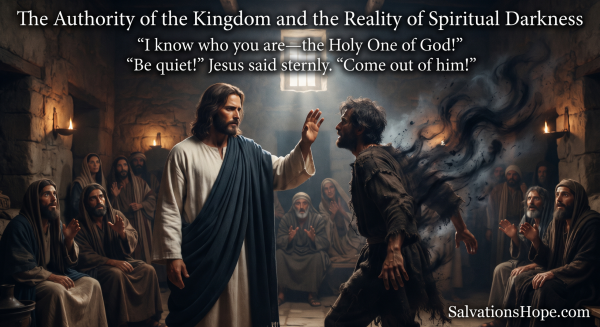
“I know who you are—the Holy One of God!” “Be quiet!” Jesus said sternly. “Come out of him!” (Luke 4:34–35)
The behavior of the demonic entity in the synagogue reveals crucial spiritual truths regarding the supernatural realm’s perception of Jesus.
Orthodox Confession Without Saving Faith: The demon articulates precise, orthodox theology: Jesus is recognized as “the Holy One of God” and later as “the Son of God” (v. 41). This proves that intellectual assent or correct theological labeling is not identical to saving faith. As James reminds us, “Even the demons believe—and shudder” (James 2:19). Knowledge of Christ’s identity, without submission to His lordship, yields only terror, not transformation.
The Rejection of Demonic Testimony: Jesus strictly silences the spirit. He refuses to accept testimony concerning His identity from the lips of demons. In the divine economy, proclaiming divine truth requires holy vessels, not unclean spirits. Jesus guards the revelation of His messianic identity, ensuring His mission is understood through sacrificial love and suffering service rather than supernatural sensationalism dictated by the powers of darkness.
Absolute Authority in Command: Without incantations, rituals, or protracted struggles, Jesus issues a direct, sovereign command: “Be quiet! Come out of him!” The result is immediate and decisive. The demon yields, throwing the man down in a final, impotent display of malice, but departs without injuring him (v. 35). Christ’s power is superior, protective, and complete.
The Broader Horizon: Comprehensive Healing and Messianic Fulfillment (Luke 4:38–41)
Luke seamlessly transitions from deliverance in the synagogue to healing Simon’s mother-in-law and gathering the sick at sunset. This structural flow is deeply theological.
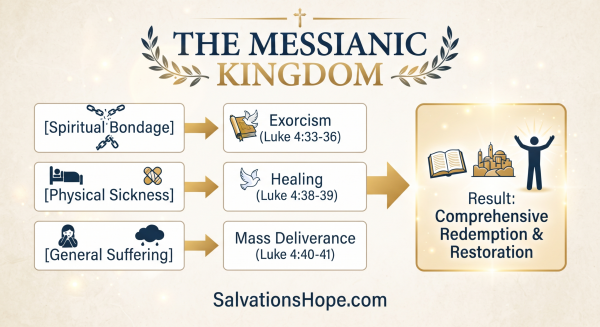
The Eradication of the Curse: In biblical theology, sickness, fever, physical decay, and demonic oppression all flow from the Fall. When Jesus rebukes Simon’s mother-in-law’s fever—treating the fever almost as an active, hostile intruder—and when he lays hands on the multitudes at sunset, he is rolling back the curse of sin.
Fulfilling Isaiah’s Prophecy: These acts directly fulfill the Isaianic expectations of the Messianic age (Isaiah 53:4, Matthew 8:16–17). Jesus demonstrates that the Kingdom of God is a comprehensive restorative force, redeeming both soul and body, breaking every chain of spiritual and physical captivity.
Standing Firm in Christ’s Authority
The narrative of Luke 4:31–41 anchors the believer’s confidence not in human capability, psychological techniques, or superstitious rituals, but in the unassailable authority of Jesus Christ. Demons tremble at His word, sickness flees at His touch, and His sovereign command shatters human bondage.
For the church today, this passage serves as both a grave reminder of spiritual darkness’s active presence and an encouraging declaration of victory. Because Christ holds all authority in heaven and on earth, His people can approach spiritual warfare and human suffering with profound realism, deep compassion, and unwavering trust in the Savior’s triumphant power.
The Cosmic Conquest and Present Victory
The Ultimate Purpose of the Incarnation
Jesus Christ’s ministry cannot be reduced to mere moral instruction or humanitarian compassion. As the Apostle John declares, “The reason the Son of God appeared was to destroy the devil’s work” (1 John 3:8). The confrontations between Jesus and the powers of darkness—such as those witnessed in the synagogues and streets of Galilee—were skirmishes of a much larger cosmic war.
When the demonic entities in Luke 4 shriek in terror and ask, “Have you come to destroy us?” they recognize the advance of their ultimate conqueror. While the complete final sentencing of Satan into the lake of fire awaits the eschaton (Revelation 20:10), Christ’s earthly ministry signaled the definitive breaking of Satan’s dominion. This theological continuation explores the nature of demonic exposure, Christ’s rejection of impure testimony, the supremacy of His divine command, and the ultimate victory secured at the cross.
The Exposure of Darkness in the Presence of Holiness
In Jesus’ presence, concealment is impossible. The text notes that the demonized individual was present in the religious assembly, perhaps unnoticed or assumed to be merely struggling with internal turmoil. Yet Christ’s absolute holiness acts as a spiritual catalyst.
- The Agitation of Evil: Just as light instantly exposes and scatters darkness, the Son of God's unblemished purity forces hidden spiritual affliction into the open. The demons cannot remain dormant or neutral in the immediate presence of the incarnate God.
- Premature Dread: The demonic outcries reflect a fearful dread of being judged prematurely. They know their ultimate destiny is destruction, and they perceive in Jesus the executioner of that divine sentence.
The Rejection of Unclean Testimony
A fascinating theological nuance in this and parallel passages is Jesus’ absolute refusal to accept true confessions from demonic sources. When the spirits cry out, “You are the Son of God!” Jesus rebukes them and commands them to be silent (Luke 4:41; cf. Acts 16:17 with Paul and the slave girl).
The Purity of Witness: God does not require Hell’s endorsement to validate Heaven’s identity. Divine truth must be proclaimed by holy vessels—the Father, the Holy Spirit, and redeemed human witnesses transformed by grace—not by agents of deception.
Controlling the Narrative: Jesus guarded the trajectory of His messianic revelation. He refused to allow His identity to be defined or broadcast by the kingdom of darkness, ensuring that His mission would be understood through His substitutionary sacrifice rather than sensationalized spiritual spectacles dictated by demons.
Rank, Power, and the Supreme Command
The crowds marveled at Jesus because His commands carried both exousia (authority/rank) and dynamis (power/strength).
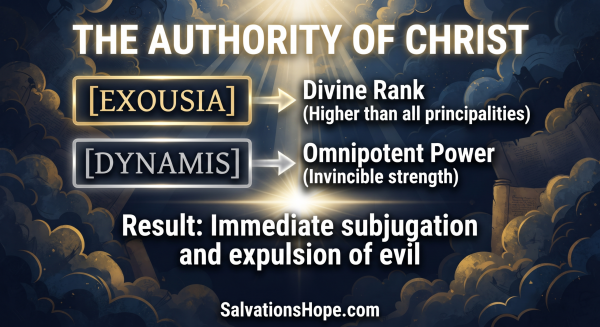
Rank (Exousia): Jesus possesses the supreme rank of Creator and Sovereign. He holds jurisdictional supremacy over every angelic and demonic hierarchy in the universe (Colossians 1:16).
Power (Dynamis): He possesses the raw, invincible strength to enforce His rank. When He speaks a word of command (“Go!”), created spiritual entities have no ontological choice but to obey. There are no protracted incantations or rituals; His spoken word is absolute law in the spiritual realm.
The Decisive Triumph of the Cross
While Christ’s earthly ministry demonstrated His authority over individual demons one by one, His supreme act of deliverance was accomplished at Calvary and validated by His resurrection.
Colossian Theology of Liberation: Paul writes that God
and authorities and put them to open shame, by triumphing over them in him” (Colossians 1:13–14; 2:15)
The Legal Dismantling of Accusation: The cross did not merely drive out local demons; it permanently shattered the legal standing of Satan’s kingdom. By paying the penalty for sin through His shed blood, Christ removed every legal accusation that Satan and his forces could level against the redeemed. Believers are no longer under demonic ownership; they are legally and spiritually purchased possessions of Almighty God.
Deliverance Today: Power Encounters and Truth Encounters
Understanding this cosmic victory shapes how the contemporary church understands spiritual warfare and deliverance. True deliverance operates on two foundational biblical pillars:

The Power Encounter: Using Jesus Christ’s delegated authority to stand against spiritual oppression, recognizing that He who is in the believer is greater than he who is in the world (1 John 4:4).
The Truth Encounter: Grounding the mind daily in the victory of the cross. Deliverance is sustained through intentional renewal of the mind—knowing who you are in Christ, being continually filled with the Holy Spirit, and walking in active obedience so the enemy has no foothold (Ephesians 4:27).
Living in the Conquered Realm
The spiritual landscape of this present age is largely a mop-up operation. The decisive battle has been fought, the enemy disarmed, and the ultimate victor enthroned in glory.
For the believer, deliverance is not a desperate struggle to gain the upper hand against an equal adversary, but the joyful, confident enforcement of a victory already won. We stand not toward victory, but from victory, living fully in the unassailable freedom Jesus Christ purchased.
Power Encounters and Truth Encounters
The Dual Dimensions of Spiritual Freedom
As the church navigates the realities of spiritual warfare in the modern age, pastoral theology recognizes that Christ’s historic victory applies to everyday believers in diverse ways. Building on the cross’s cosmic triumph and the authority established during Christ’s earthly ministry, theologians and pastors generally categorize contemporary deliverance into two primary methodologies: the power encounter and the truth encounter.
While both find warrant and precedent in Scripture, applying them properly ensures the church neither minimizes the reality of active spiritual affliction nor reduces the enemy’s subtle, pervasive deceptions to mere physical or psychological phenomena.
The Power Encounter: Direct Confrontation and Authority
A power encounter is a direct, head-on confrontation with a demonic force, utilizing the delegated authority (exousia) of Jesus Christ to command an unclean spirit to depart from an afflicted person or a spiritually oppressed environment.
The Basis of Authority: Believers do not possess inherent supernatural muscle; rather, they exercise authority derived solely from union with Christ. As Jesus delegated authority to His disciples during His earthly ministry (Luke 10:17–19) and promised the abiding power of the Holy Spirit (Acts 1:8), the church retains the standing to command darkness to flee in the matchless name of Jesus.
The Necessity in Acute Cases: While many contemporary Western contexts lean heavily toward purely psychological or medical frameworks, biblical realism acknowledges that acute, severe spiritual bondage can sometimes blind an individual to the point where they cannot rationally process or receive theological truth. In rare, profound cases of direct demonization, an authoritative command in Christ’s name breaks through the fog of oppression, restoring the cognitive and spiritual clarity the individual needs to hear and respond to the gospel.
The Truth Encounter: Renewing the Mind and Dispelling Deception
While power encounters address acute, manifest spiritual crises, the truth encounter is the more frequent, normative pathway to deliverance and spiritual stability for most believers.
Deception as the Primary Weapon: The devil is described as “a liar and the father of lies” (John 8:44). Much of the functional power that demonic forces exert over individuals—even within the church—operates not through bizarre, cinematic manifestations, but through quiet, insidious deception, accusation, and stronghold-building in thought patterns.
The Process of Liberation: A truth encounter involves deep-seated spiritual formation:
- Renewing the Mind: Immerse yourself in Scripture and let the Holy Spirit reshape deeply ingrained cognitive and emotional patterns (Romans 12:2).
- Resting in Finished Victory: Trusting wholly in Christ's finished, blood-bought work, knowing the cross canceled legal accusation.
- Living Out True Identity: Experientially grasping what it means to be a co-heir with Christ, indwelt and sealed by the Holy Spirit, leaving no structural room or foothold for the enemy to inhabit (Ephesians 4:27).
Discerning the Manifestations: Acute Demonization vs. Subtle Subjugation
Scripture presents a clear distinction between the rare, highly visible forms of demonization and the everyday, subtle warfare waged against well-adjusted, normal people.
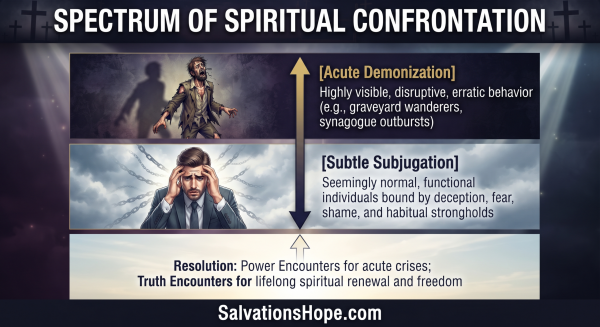
The Visibly Afflicted: In the Gospels, those directly demonized often showed erratic, destructive, or socially isolating behavior—such as the Gerasene demoniac or the man in the Capernaum synagogue. Their distress was externally pronounced.
The Quietly Bound: Conversely, most people—including dedicated churchgoers—who need rescue from the evil one’s grip do not exhibit bizarre, supernatural outbursts. Instead, they struggle with chronic despair, debilitating fear, spiritual apathy, ungodly coping mechanisms, and systematic lies about God’s character and their own worth. For these individuals, a protracted shouting match with spirits is neither necessary nor biblically prescribed; rather, the “normal path” of deliverance is the steady, transformative immersion in the truth of the gospel and the empowering guidance of the Holy Spirit.
Walking in Established Freedom
Whether a believer experiences deliverance through a dramatic moment of spiritual rescue or through the gradual, beautiful dismantling of deception via the Word of God, the source of freedom remains identical.
Deliverance is not about mastering techniques, memorizing formulas, or cataloging demonic hierarchies; it is about looking away from ourselves and anchoring our souls in the supreme authority, unstoppable power, and unfailing love of Jesus Christ. As we walk in the Spirit, fill our minds with His truth, and lean upon His finished victory, we live out the profound reality of true spiritual freedom.
Cleaning the House: The Danger of Emptiness and the Fullness of the Spirit
Beyond Sweeping—The Necessity of Divine Residence
Deliverance from spiritual oppression is not passive, nor is it a sterile, once-and-for-all cleanup. In Jesus’ teaching and the apostolic epistles, securing freedom from spiritual darkness requires far more than evicting unwanted influences or changing outward behavior. Using vivid imagery—from rats and garbage to occupied houses and returning spirits—Scripture warns that an empty, un-indwelt life remains dangerously vulnerable to a hostile takeover.
True, lasting deliverance demands a fundamental reorientation of the human soul: moving from empty reformation to radical, Spirit-filled submission to God.
The Analogy of the Infestation: Addressing the Root Conditions
To illustrate the mechanics of spiritual vulnerability, pastors and theologians often use everyday analogies, while keeping their theological limitations in mind.
The Fallacy of Superficial Eviction: If a house is overrun with rats because of accumulated garbage, simply chasing the rats away with a stick offers only temporary relief. If the garbage remains untouched, the environment keeps attracting pests, and the infestation inevitably returns.
The Nuance of Suffering and Sin: While unrepented sin, persistent rebellion, and worldly compromise can certainly provide footholds (topos) for the enemy (Ephesians 4:27), biblical fidelity requires us to remember that severe spiritual attack is not always a direct, proportional indicator of a massive “pile of garbage.” Believers can undergo intense seasons of spiritual assault due to external trials, spiritual warfare, or physical and emotional exhaustion—much like an abused spouse who suffers profound oppression through no fault of their own.
The Role of Truth and Repentance: Nevertheless, in the normative process of a truth encounter, clearing out the clutter of ungodliness, toxic patterns, and compromise removes the environmental conditions that foster spiritual decay, leaving less room for deception to take root.
The Danger of the Unoccupied House (Matthew 12:43–45)
One of the most sobering warnings regarding spiritual deliverance is found in Jesus’ parable of the vacant house:
“When an impure spirit comes out of a person, it goes through arid places seeking rest and does not find it. Then it says, ‘I will return to the house I left.’ When it arrives, it finds the house unoccupied, swept clean and put in order. Then it goes and takes with it seven other spirits more wicked than itself, and they go in and live there. And the final condition of that person is worse than the first.” (Matthew 12:43–45)
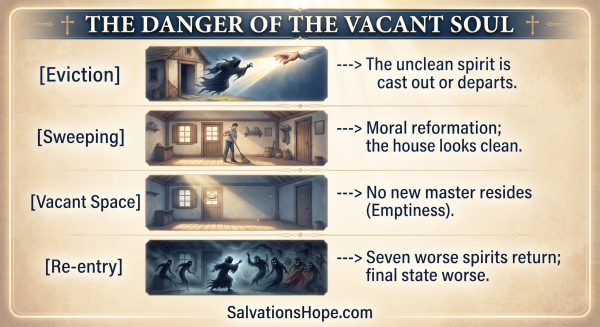
The Problem of Neutrality: Moral reformation, self-help psychology, and ethical self-discipline can sweep the house clean, leaving it looking orderly on the outside. However, if the heart remains spiritually vacant—unanchored to Christ and devoid of the indwelling Holy Spirit—it remains vulnerable.
The Escalation of Darkness: A neutral soul is a contradiction in terms within the spiritual realm. An empty heart cleared of old vices but not filled with God’s righteousness invites a compounded spiritual assault, where the last state becomes worse than the first.
Binding the Strong Man and Radical Replacement
Jesus explicitly identified His ministry as a divine invasion that breaks darkness’s monopoly: “Or again, how can anyone enter a strong man’s house and carry off his possessions unless he first ties up the strong man? Then he can plunder his house” (Matthew 12:29).
Christ’s Sovereign Intervention: Jesus is the greater Strong Man who binds the usurper (Satan), strips him of his assumed authority, and reclaims what rightfully belongs to God.
The Law of Divine Displacement: The ultimate remedy for spiritual emptiness is not a vacuum, but a divine replacement. You cannot defeat darkness by simply turning it off; you must introduce light. Similarly, deliverance is fully realized only when the soul is systematically, passionately, and continually filled with the person of the Holy Spirit.
The Two-Part Rhythm: Submit and Resist (James 4:7–8; Ephesians 4:27, 30)
The New Testament outlines a dynamic, ongoing lifestyle of freedom that synthesizes submission and resistance:
Submit to God: “Submit yourselves, then, to God. Resist the devil, and he will flee from you. Come near to God, and he will come near to you” (James 4:7–8). True spiritual defense begins with complete surrender to Christ’s lordship.
Resist the Enemy: Armed with Jesus’ delegated authority, the believer actively stands against temptation and deceit.
Guard the Temple: Ephesians 4:27 and 4:30 form a vital theological pair: “Do not give the devil a place” and “Do not grieve the Holy Spirit of God.” When ungodly behavior, bitterness, or unconfessed sin grieves the Holy Spirit and causes Him to withdraw His conscious, empowering presence from our daily walk, a spiritual vacuum opens—a “place” or foothold for the adversary. Conversely, maintaining a tender, responsive heart to the Holy Spirit ensures the rightful Owner fully occupies the residence.
Living in the Fullness of Grace
Deliverance ultimately invites wholehearted, unreserved discipleship. It calls us to move beyond superficial fixes or temporary spiritual housekeeping and to anchor our lives deeply in the triune God. By submitting our will to the Father, resting in the Son’s finished victory, and keeping our hearts saturated with the Holy Spirit, we leave no room for the enemy and walk instead in the unshakeable liberty of God’s children.
Areas of Deliverance: Breaking Footholds in Idols and Lies
Practical Arenas of Spiritual Freedom
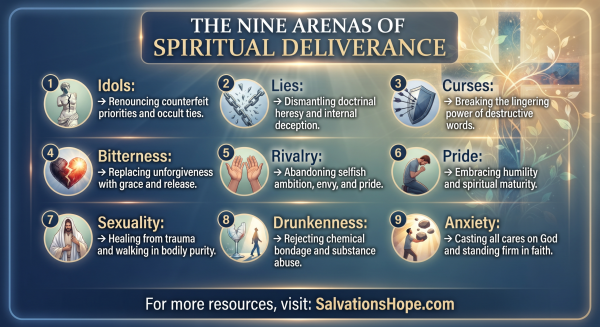
Experiencing the fullness of Christ’s deliverance requires more than a generalized theological recognition of victory; it demands specific, intentional engagement across the practical arenas of human life. Scripture pairs various worldly traps, strongholds, and sins with the direct activity of Satan and his demonic hierarchy (such as idols, lies, curses, bitterness, rivalry, pride, sexual immorality, drunkenness, and anxiety).
To walk in uncompromised freedom, believers must identify these spiritual entry points, renounce every counterfeit allegiance, repent of sin, and invite God’s sovereign reign into every facet of daily life.
The Realm of Idols: Renouncing Counterfeit Loyalties (1 Corinthians 10:20)
“The sacrifices of pagans are offered to demons, not to God, and I do not want you to be participants with demons.” (1 Corinthians 10:20)
A common modern misconception is to view non-Christian religions, esoteric philosophies, or occult practices as merely empty systems of thought devoid of real spiritual substance. However, biblical theology reveals that behind false religions and occult involvement lie active, malevolent spiritual powers.
Explicit Occult Entanglements: Involvement in non-Christian religious rites, occult practices, divination, or games and activities that deliberately invoke hidden or spiritual forces creates a spiritual partnership with darkness. True deliverance begins by identifying these involvements, speaking a deliberate, verbal renunciation (“I renounce the devil and reject all involvement with occult powers”), and turning wholly to Christ.
Functional Idolatry: Idols aren’t limited to carved statues in ancient temples; they appear whenever we elevate anything in life above God.
- The Trap of Mammon: Money and material security are neutral in themselves, but when we make wealth our ultimate trust, safety, and highest priority, it becomes a false god—Mammon—operating under demonic influence.
- Response: Believers must audit their core priorities, confess modern idolatry as sin, and afresh declare that Jesus alone holds supreme, uncontested preeminence.
The Realm of Lies: Dismantling Deception and Accusation (John 8:44; 1 Timothy 4:1)
As Jesus declared, Satan is “a liar, and the father of lies” (John 8:44). Deception is the primary currency of the kingdom of darkness, operating both on a macro-theological scale and through deeply personal, insidious internal narratives.
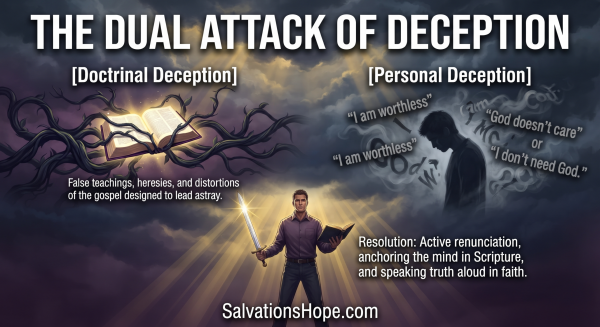
Doctrinal Heresy: Paul warns that later on some will abandon the faith by following deceiving spirits and doctrines taught by demons (1 Timothy 4:1). The church must continually evaluate its teachings against Scripture’s uncompromised standard and reject any philosophy that undermines the gospel of grace.
Internalized Lies and False Moods: Deception often whispers directly into the human heart, producing misleading emotional states and toxic core beliefs:
- "I am worthless."
- "God doesn't care about my pain."
- "I have no future with God."
- Alternatively, the prideful illusion of self-sufficiency: "I’m doing great; who needs God?"
The Practice of Renunciation: Deliverance in this arena requires bringing these unspoken, misleading moods and false beliefs into conscious awareness. Believers must actively speak out loud against them: “I renounce the lie that I am worthless. I renounce the lie that God is indifferent to me.” By replacing deception with the unchanging truth of God’s Word, the enemy’s deceptions lose their binding power.
The Power of Truth and the Danger of Destructive Words
Rescuing Captives Through Grace and Confronting the Power of the Tongue
As we continue exploring the practical arenas of deliverance, the pastoral task shifts from direct confrontation to the patient, persistent application of truth and the dismantling of verbal strongholds. The kingdom of darkness relies heavily on deception, entrapment, and the corrosive power of destructive words. Moving through these arenas requires deep biblical discernment, gentle instruction, and an unshakable commitment to the gospel’s healing power.
The Method of the Truth Encounter: Rescuing Captives (2 Timothy 2:25–26)
When dealing with individuals captured by the adversary to do his will, Scripture outlines a posture quite distinct from aggressive exorcism:
“Opponents must be gently instructed, in the hope that God will grant them repentance leading them to a knowledge of the truth, and that they will come to their senses and escape from the trap of the devil, who has taken them captive to do his will” (2 Timothy 2:25–26).
Gentle Instruction vs. Brute Force: Many people trapped in spiritual deception or ideological strongholds don’t need a public power encounter; they need the steady, luminous dawn of biblical truth.
Prying Open the Trap: As the gospel is brought lovingly, clearly, and persistently, the jaws of the devil’s trap begin to pry open. Truth dismantles the foundational lies that built the captivity, offering true and lasting deliverance.
The Realm of Curses: The Fire of the Tongue (James 3:6, 9)
James paints a terrifyingly vivid picture of destructive speech:
“The tongue is a fire; it sets the whole course of one’s life on fire, and is itself set on fire by hell” (James 3:6)
The Devastation of Verbal Abuse: Words spoken in anger, malice, or rejection—especially by parents, authority figures, or those closest to us—can leave deep, festering wounds. When spoken over a child or a vulnerable person, these degrading words can function as curses that haunt an individual for decades.
The Cycle of Hellfire: Because the tongue can be ignited by hellish animosity, those exposed to it often internalize the hostility.
Renouncing Ancient Wounds: Breaking free from the lingering impact of past curses requires bringing those hidden wounds into the light. With the assistance of a trusted pastor, counselor, or mature believer, individuals can identify the destructive words spoken over them, recognize them as products of spiritual darkness, and make a conscious, verbal renunciation: “That was a curse set on fire by hell. In the name of Jesus, I reject that evaluation, I reject that lie, and I break agreement with those words.”
The Perpetuation of Evil: Spiritual Stockholm Syndrome
One of the most tragic psychological and spiritual dynamics of demonic oppression is how evil begins to perpetuate itself through the victim.
The Analogy of Stockholm Syndrome: In hostage situations, captives who are browbeaten and controlled over prolonged periods eventually begin to sympathize with, defend, and emulate their captors.
Spiritual Assimilation: Similarly, when individuals remain under the heavy influence of demonic strongholds, bitterness, or recurring sin, they can eventually begin to think, act, and react like the very darkness that oppresses them. Breaking this cycle requires radical divine intervention, a renewed identity in Christ, and a conscious surrender to the liberating presence of the Holy Spirit.
The Spiritual Stockholm Syndrome
Captives Allied with the Captor
One of the most insidious and heartbreaking stratagems of the kingdom of darkness is its ability to induce a spiritual equivalent of Stockholm syndrome. In criminal psychology, Stockholm syndrome describes how hostages, subjected to prolonged terror, isolation, and abuse by their captors, eventually begin to sympathize with, defend, and emulate them.
In the spiritual realm, this psychological dynamic manifests whenever individuals who have been wounded, deceived, or violated by sin and demonic influence begin to embrace, normalize, and even defend the very forces that are destroying them. Recognizing this captivity is the first vital step toward receiving the true, lasting deliverance Jesus Christ offers.
Distorting the Image of God: The Roots of Rebellion
When demonic influence operates within families, communities, or even compromised religious institutions, one of its primary targets is the human perception of God.
Misrepresenting the Father: Through abusive parenting, harsh legalism, or hypocrisy, a distorted caricature of God is projected onto vulnerable children and seekers.
The Trajectory of Resentment: Growing up in such misery, individuals often reach a tragic conclusion: “If this is what God is like, I want nothing to do with Him.” By rejecting God, they unknowingly side with the spiritual forces that orchestrated the abuse in the first place. They have taken the captor’s side, turning their backs on the only One who can truly set them free.
The Cycle of Trauma and Normalization in Sexuality and Behavior
The tragedy of spiritual Stockholm syndrome extends deeply into behavioral patterns and relational brokenness, where the victims of exploitation or abuse are conditioned to embrace their wounding as identity.
Trauma and Deviance: Statistical research across sociological and public health domains repeatedly demonstrates that severe early-life trauma, abuse, or boundary violations significantly correlate with subsequent struggles in identity and behavior in adulthood.
Rationalizing the Wound: When cultural or governmental systems validate behaviors born out of profound trauma—labeling destructive or unnatural patterns as healthy or normal—society resembles Stockholm syndrome. Rather than seeking healing and the restorative grace of God, individuals are encouraged to celebrate the very conditions rooted in their violation.
The Perpetuation of Abuse: The cyclical nature of sin ensures that those who are cruelly treated often find themselves, in adulthood, mimicking the behavior of their abusers toward others. Unresolved trauma, when left unaddressed by the gospel, perpetuates a generational cycle of darkness.
Compassion for the Captive vs. Accommodation of the Captor
Steering through these deep waters requires the church to hold two vital biblical truths in precise tension: profound pastoral compassion and uncompromising theological truth.
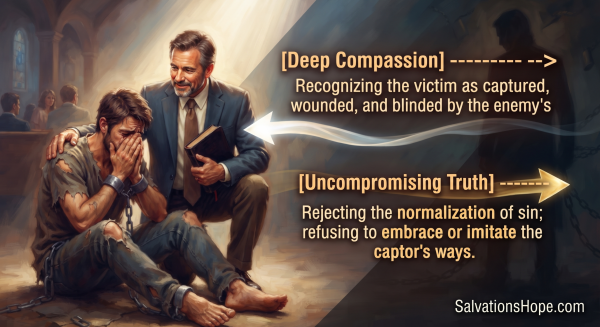
The Call for Compassion: We must never meet the victims of abuse, addiction, or profound deception with self-righteous condemnation. Jesus wept with the broken, and His heart overflows with mercy for those who have been enslaved and controlled by evil powers.
Refusing Emulation: Compassion, however, does not mean accommodation. To embrace sin, normalize trauma, or side with the enemy’s narrative is to remain trapped in Stockholm syndrome. True deliverance means waking from the fog of deception, renouncing the captor’s lies, and turning to Christ.
Jesus as the Ultimate Deliverer
The nature of the demonic is fundamentally destructive: it harms you, fools you into participating in your own degradation, and finally convinces you that the chains are normal.
Jesus Christ did not come to validate our bondages, nor did He come to co-exist with our strongholds. He came as the ultimate Deliverer—to break every chain, shatter every curse, dismantle every lie, and liberate the captive soul. By turning away from the false securities of our wounds and submitting our entire lives to His reign, we step out of darkness and into the glorious freedom of the sons of God.
The Trap of Bitterness and the Liberating Power of Forgiveness
The Open Door of Unforgiveness
As we trace the arenas where demonic influence seeks to establish a foothold in human lives, few are as strategically leveraged by the enemy as bitterness and unresolved anger. The Apostle Paul explicitly links emotional and relational friction with spiritual vulnerability when he writes:
(Ephesians 4:26–32).
When anger hardens into resentment and refusing to forgive becomes a settled disposition, the soul grants an active lease to the adversary. Understanding how bitterness works, recognizing its spiritual consequences, and practicing biblical forgiveness are essential to walking in complete deliverance.
The Theological Link Between Anger, Grieving the Spirit, and Satan’s Foothold
Paul places two commands in immediate parallel: “give no place to the devil” and “do not grieve the Holy Spirit of God.”
The Grieving of the Paraklete: The Holy Spirit is the divine Comforter and Counselor who indwells the believer. When a heart chooses to harbor malice, rage, and vindictive anger, it pollutes the temple’s atmosphere. The Spirit is grieved by the internal contradiction of harboring hatred while bearing the name of a forgiving Savior.
The Vacation of the Spirit and Occupation of the Enemy: As the conscious, empowering presence of the Holy Spirit is grieved and withdraws its active comfort, a spiritual vacuum is created. Into that vacancy steps the adversary. Harboring anger beyond sundown is a direct invitation: “Come on in.” Unforgiveness becomes the welcome mat for demonic manipulation, distorting our perception of others and blinding us to our own spiritual decay.
Playing Into Satan’s Playbook: Paul’s Warning to the Corinthians
The danger of unforgiveness is not merely personal; it has profound corporate implications for the church. Addressing the need to restore a repentant sinner within the community, Paul writes:
“Anyone you forgive, I also forgive. And what I have forgiven—if there was anything to forgive—I have forgiven in the sight of Christ for your sake, in order that Satan might not outwit us. For we are not unaware of his schemes” (2 Corinthians 2:10–11).
Outwitted by the Enemy: When believers cling to grudges, nurse grievances, or refuse to extend grace where repentance is offered, they are unwittingly executing Satan’s playbook. Division, factionalism, and bitterness are the primary tools the enemy uses to fracture Christian fellowship.
Awareness of Schemes: Spiritual maturity requires recognizing that an unforgiving spirit is never a neutral emotional stance. It is tactically aligned with the kingdom of darkness, letting past injuries dictate present disobedience.
Redefining Forgiveness: Absorption, Boundaries, and Realism
A major hindrance to biblical forgiveness is the common misconception of what forgiveness actually entails. Many avoid forgiving because they mistakenly believe it requires emotional amnesia, minimizing real evil, or forcing naive reconciliation. Scripture presents a much more realistic and liberating framework:
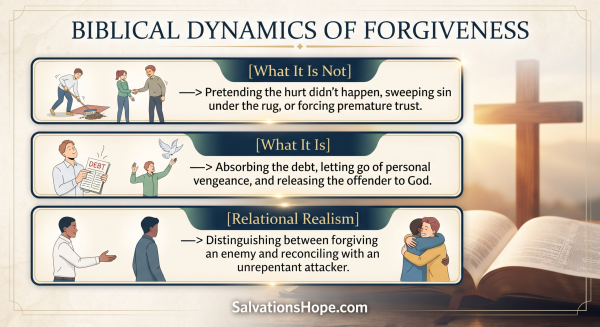
Absorbing the Hurt: Forgiveness does not mean saying, “Oh, it’s okay, it doesn’t matter.” True forgiveness acknowledges a grievous wrong, refuses to demand personal retaliation, and absorbs the cost of the hurt, mirroring how Christ absorbed our sin.
Forgiveness vs. Reconciliation:
Reconciliation requires repentance, mutual trust, and rebuilding the relationship (Luke 17:3–4).
Forgiveness is a unilateral act of releasing the debt before God. As Jesus commanded, we are called to pray for our enemies (Matthew 5:44). If an abuser or unrepentant attacker remains hostile, a believer can fully forgive them in their heart while maintaining healthy, protective boundaries. You do not have to pretend an active attacker is a safe companion; you release them into God’s hands and pray for their repentance from a distance.
The Double Liberation: Releasing the Captive Frees You
When we refuse to forgive, we imagine we are keeping our offender locked in a prison of our resentment. In reality, we lock ourselves inside.
The Principle of Self-Imprisonment: Bitterness acts as an internal poison. Unforgiveness binds the soul to the past, forcing the victim to continually relive the trauma through the lens of ongoing hatred.
The Dual Cleansing: Total spiritual freedom requires a two-directional application of grace:
Receiving Cleansing: Bring our failures, sins, and complicity to God; apply the blood of Christ through confession (“If we confess our sins, he is faithful and just and will forgive us” – 1 John 1:9); and renounce any influence of the enemy.
Extending Release: In the unearned power of that divine forgiveness, extending release to those who have wounded us.
When you finally forgive someone through the strength of the Holy Spirit, you discover a profound, startling truth: you are the captive set free. By letting go of the grudge, you dismantle Satan’s scheme, grieve the forces of darkness, and walk forth in the pristine, unhindered liberty of the children of God.
Dismantling Satanic Strongholds in Body and Spirit
The Multidimensional Tactics of the Adversary: Rivalry, Pride, Sexuality, and Addiction
As we continue exploring the practical arenas of deliverance, we broaden to include some of the most deeply ingrained, culturally normalized struggles of human existence. The kingdom of darkness does not limit its operations to overt occultism or theological heresy; it aggressively exploits human ambition, ego, relational intimacy, and bodily vulnerabilities.
Scripture exposes how rivalry, pride, sexual brokenness, and chemical addiction serve as strategic entry points for spiritual oppression. Identifying these strongholds, bringing them into the light of divine truth, and applying the cleansing power of the gospel are essential steps toward walking in total, uncompromised freedom.
The Trap of Rivalry and Selfish Ambition (James 3:14–15)
Modern society often celebrates the human drive to outrank, outperform, and outshine others as healthy competition or drive. However, Scripture offers a sobering diagnosis of this relentless need to be the “top dog”:
come down from heaven but is earthly, unspiritual, demonic” (James 3:14–15).
The Echo of Satan’s Rebellion: Rivalry’s root lies in Satan’s original rebellion. Dissatisfied with his exalted yet created rank in the angelic hierarchy, Lucifer demanded a position equal to or above God. That unyielding refusal to accept our creaturely status—manifested in the constant need to exalt ourselves, secure our worth at others’ expense, and step on people to get ahead—is fundamentally demonic in origin.
The Path of Deliverance: Walking in freedom requires an honest internal audit: Where am I trying to one-up someone else? Where is my sense of worth dependent on knocking another person down? Recognizing this drive as earthly and unspiritual enables the believer to renounce selfish ambition, embrace godly humility, and find complete security in their identity as a beloved child of God.
The Danger of Pride and Premature Promotion (1 Timothy 3:6–7)
Closely related to rivalry is pride, the adversary’s foundational sin. The Apostle Paul explicitly warns against the spiritual hazard of elevating immature individuals to positions of prominent leadership:
“Such a person should not be a recent convert, or he may become conceited and fall under the same judgment as the devil. He must also have a good reputation with outsiders, so that he will not fall into disgrace and into the devil’s trap” (1 Timothy 3:6–7).
The Echo of Satan’s Rebellion: Rivalry’s root lies in Satan’s original rebellion. Dissatisfied with his exalted yet created rank in the angelic hierarchy, Lucifer demanded a position equal to or above God. That unyielding refusal to accept our creaturely status—manifested in the constant need to exalt ourselves, secure our worth at others’ expense, and step on people to get ahead—is fundamentally demonic in origin.
The Path of Deliverance: Walking in freedom requires an honest internal audit: Where am I trying to one-up someone else? Where is my sense of worth dependent on knocking another person down? Recognizing this drive as earthly and unspiritual enables the believer to renounce selfish ambition, embrace godly humility, and find complete security in their identity as a beloved child of God.
The Danger of Pride and Premature Promotion (1 Timothy 3:6–7)
Closely related to rivalry is pride, the adversary’s foundational sin. The Apostle Paul explicitly warns against the spiritual hazard of elevating immature individuals to positions of prominent leadership:
“Such a person should not be a recent convert, or he may become conceited and fall under the same judgment as the devil. He must also have a good reputation with outsiders, so that he will not fall into disgrace and into the devil’s trap” (1 Timothy 3:6–7)
The Danger of Celebrity Culture: In broader contemporary Christian circles, there is often a dangerous rush to platform famous personalities or cultural figures immediately after they convert. These individuals may be “famous babies,” but spiritually they remain infants. Promoting them before they have undergone deep character formation and maturation invites spiritual disaster, feeding the exact pride for which the devil was condemned.
The Standard of Maturity: True spiritual leadership requires brokenness, tested character, and genuine humility—qualities forged over time through steady perseverance in the faith.
Sexual Purity and the Healing of Deep Wounds (1 Corinthians 6:16; 7:5)
The realm of human sexuality is one of the primary battlegrounds where Satan seeks to inflict deep, long-lasting harm, twist divine design, and establish strongholds of bondage.
The Spiritual Union of Intimacy: Scripture teaches that sexual union is not merely a biological or recreational act; it creates a profound, one-flesh bond (“He who unites himself with a prostitute is one with her in body” – 1 Corinthians 6:16). Unhealthy, illicit, or abusive sexual unions entangle the soul in ways that secular culture refuses to acknowledge.
The Tragedy of Exploitation: Many individuals carry deep trauma from being exploited sexually in their youth by trusted authorities, family members, or peers. Paradoxically, the enemy often attempts to use the evil committed against the victim to generate misplaced shame, making them feel defiled by another’s sin.
Breaking the Chains: Deliverance in this arena means bringing hidden violations into the light and recognizing that bodily purity supports spiritual liberty, while bodily impurity contributes to spiritual bondage. Believers must actively renounce past violations and illicit unions, declaring: I reject and renounce that action, and I claim complete freedom and cleansing in the blood of Jesus.”
Substance Abuse and the Deception of Addiction (Ephesians 5:18–19)
Chemical addiction and drunkenness represent another devastating avenue through which the human spirit is compromised and exposed to invasion.
“Do not get drunk on wine, which leads to debauchery. Instead, be filled with the Spirit…” (Ephesians 5:18–19)
Opening the Spirit to Invasion: Altering our state of consciousness through chemical dependency or excessive intoxication does more than impair physical coordination; it weakens our spiritual defenses and invites invasion by malevolent spiritual forces. Demons actively exploit addiction, leveraging our vulnerabilities when we are not in our right mind.
Beyond the Disease Model: While modern psychological and medical frameworks give important understanding of addiction, a purely clinical model often falls short of capturing its true spiritual gravity. The deadliest power of addiction is its capacity for self-deception—making it nearly impossible for the individual to see their condition objectively or acknowledge their desperate need for God.
Surrender and Divine Power: Overcoming addiction requires moving beyond self-reliance. It demands acknowledging that we cannot conquer these destructive powers on our own. On our own, true recovery is found when an individual renounces the false promises of addiction, confesses their helplessness, and invites the indwelling power of the Holy Spirit to reclaim and govern their life.
The Trap of Anxiety, Pastoral Discernment, and the Triumphant Victory in Christ
The Weaponization of Fear and the Tender Compassion of the Savior
As we conclude our comprehensive examination of the practical arenas where the kingdom of darkness seeks to establish strongholds, we arrive at one of the most pervasive human struggles of the modern age: anxiety. The Apostle Peter explicitly connects our emotional equilibrium with our spiritual vigilance when he writes:
like a roaring lion, looking for someone to devour. Resist him, standing firm in the faith” (1 Peter 5:7–9).
Rather than viewing anxiety as a completely isolated psychological phenomenon, Scripture reveals that unbridled worry and chronic fear can become fertile ground for the adversary. Yet navigating this delicate terrain requires profound pastoral wisdom: carefully distinguishing between physiological vulnerability and spiritual warfare, and anchoring our souls in the unfailing tenderness of Jesus Christ.
The Dynamic Link Between Unsurrendered Anxiety and Spiritual Vulnerability (1 Peter 5:7–9)
At first glance, commanding believers not to be anxious and warning them about a roaring lion might seem like two separate exhortations. In reality, they are deeply intertwined.
The Exhaustion of Self-Reliance: When we refuse to cast our cares on the Lord—carrying the weight of tomorrow, control, and survival on our own shoulders—we become emotionally and spiritually exhausted. This fatigue compromises our spiritual alertness.
The Prowling Predator: Satan, acting like a roaring lion, seeks out the isolated, exhausted, and overwhelmed. Chronic, unsurrendered anxiety distorts our view of God’s goodness, making us prime targets for deception, despair, and doubt. By contrast, casting our anxiety on God restores our trust in His sovereignty and closes the door to the enemy’s accusations.
Distinguishing Spiritual Warfare from Biological Reality
A critical responsibility of biblical pastoral care is maintaining balance and discernment when addressing emotional and mental suffering.
Avoiding Reductionism: We must never fall into the error of attributing every manifestation of mental illness, emotional fragility, or mood disorder directly to demonic control. To suggest that every struggling, depressed, or highly anxious person is merely “demonized” is both unbiblical and pastorally cruel.
The Reality of Biological Vulnerability: Human beings are embodied souls. Biological factors, neurological chemistry, trauma, and physical exhaustion profoundly affect our moods and emotional resilience. Just as a physical illness requires medical treatment or medication, chemical or biological imbalances require appropriate physical care.
The Hall of Faith of the Weak: Some of the most profoundly faithful, spiritually courageous saints throughout history have struggled deeply with mental illness, melancholia, and trembling anxiety. God does not demand robust emotional health or unbroken psychological buoyancy before He can use us.
The Gentleness of the Good Shepherd (Isaiah 42:3)
The character of our Lord is wonderfully set against human demands for power, polish, and perfection:
“A bruised reed he will not break, and a smoldering wick he will not snuff out” (Isaiah 42:3).
Jesus does not scan the room for only the strong, brave, hearty, and healthy. He meets us precisely in our weakness, our bruising, and our flickering weariness. He takes us where we are and, through the gentle, patient work of His Spirit, conforms us bit by bit into His image.
Summary of the Nine Arenas of Deliverance
Throughout this study, we have examined nine distinct biblical arenas where the adversary seeks to establish footholds, and where the liberating power of Christ brings complete freedom:
Walking in the Fullness of Victory
Whether deliverance comes through a sudden, dramatic breakthrough or through the steady, lifelong discipline of a truth encounter—renewing the mind in Scripture, working alongside a trusted pastor or counselor, or bringing hidden vulnerabilities to God in personal prayer—the source of our freedom never changes.
When Jesus enters a life, He imparts an authority greater than any power of the evil one. By renouncing footholds, reclaiming our standing through the blood of Christ, and filling our souls with the presence of the Holy Spirit, we step out of the shadows of fear and into our Savior’s unshakeable, triumphant victory.
Walking in the Victory of Christ: The Culmination of Spiritual Deliverance
From Overwhelm to Exalted Freedom
When the human mind becomes muddled by spiritual fog, the heart grows downcast under the weight of accumulated strongholds, and the sheer magnitude of spiritual warfare feels paralyzingly complex, the path forward can seem obscured. In such moments of profound weariness, isolation is the enemy’s greatest ally. Scripture and pastoral wisdom consistently point toward the necessity of community—stepping out of the shadows, seeking out a mature believer, pastor, or counselor whose judgment is anchored in Scripture, and praying through the darkness together. The gospel’s ultimate message is startlingly simple and absolutely powerful: Christ brings deliverance.
Synthesizing this profound truth, theologian Sam Storms astutely observes: “The key to victory in spiritual warfare is knowing both what Jesus Christ has done for you and what he has done to Satan. Christians too often live in fear of what they think the devil might do but can’t, and in ignorance of what they can do but don’t.”
To live in the freedom purchased at Calvary is to refuse both extremes: we neither overestimate the petty, limited terror of a defeated adversary nor underestimate the infinite, indwelling power of the living God.
Balancing the Spectrum: Power Encounters and Normative Renewal
As we review the expansive landscape of spiritual deliverance—spanning Idols, Lies, Curses, Bitterness, Rivalry, Pride, Sexuality, Drunkenness, and Anxiety—we recognize that God’s methodology adapts to the depth of human need while remaining unalterably anchored in Christ’s supremacy.
When Direct Authority is Required: Sometimes, though less often, an individual is so heavily oppressed, disoriented, or blinded by acute demonic activity that they cannot process rational or theological truth on their own. In such profound crises, the church must not shrink from biblical realism. Following the New Testament pattern, direct intervention through a power encounter—issuing a clear, resolute command in the authority and name of Jesus Christ—is necessary to shatter the immediate fog of oppression and banish the invading darkness.
The Normative Path of Transformation: Far more frequently, however, the daily walk of deliverance occurs through the steady, transformative discipline of the truth encounter. This is the ongoing renewal of the mind through Romans 12:2:
- Realigning our thoughts with our true identity in Christ.
- Recognizing that we are new creations, chosen, adopted, and sealed by the Holy Spirit (Colossians 1:13–14).
- Systematically close every manufactured foothold (topos) as soon as you identify it, renounce deception, and invite the Holy Spirit to govern every chamber of your heart.
The Mechanics of Walking Free: Practical Steps for the Believer
To practically appropriate the victory of Christ in daily life, believers are called to engage in a continuous, active posture of faith, repentance, and surrender:
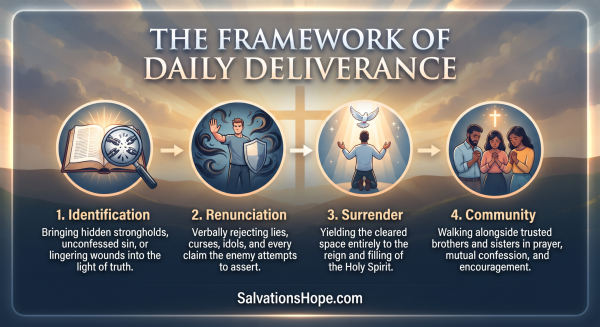
There is zero theological or spiritual warrant for any child of God to live in permanent bondage, paralyzing fear, or perpetual defeat. The cross was not a noble failure; it was a cosmic, decisive, and unchallengeable triumph.
A Pastoral Benediction and Prayer
If you struggle today—or if the Holy Spirit brings to mind a brother, sister, or neighbor trapped in the webs of deception, bitterness, or despair—let us embrace our high calling as ministers of reconciliation and instruments of divine rescue. Let us love deeply, instruct gently, and, when necessary, stand firm in our Savior’s unyielding authority to declare freedom over the captives.
Prayer for Deliverance
“Lord Jesus, we thank you for your wonderful, mighty ministry. We praise you again when we hear how, at your word, you expelled demons and unclean spirits from those oppressed by them. And we praise you above all for that great cosmic deliverance, as you triumphed over Satan and all his powers at the cross. We praise you that you have put those powers to open shame, that you, Lord Jesus, are head over all rulers and authorities and principalities and powers, that you have supreme authority and unlimited power. Lord, may we avail ourselves of that power, and may the Holy Spirit apply it in our own lives. Help each one here to know greater freedom, to know a greater sense of the Holy Spirit’s presence, and to know that the truth sets us free; that if the Son sets us free by the power of the Holy Spirit, we will be free indeed. Help each one here, Lord, who may be struggling to find that deliverance. If you bring someone to mind who needs deliverance, help us to be that helper you’ve put in their life. Help us to minister to them, to love them, to gently instruct, and—where necessary—to speak the word of rebuke to the power of evil and to bring into the glorious freedom of the children of God those who are yours. We pray in the mighty name of Christ Jesus. Amen.”
Doctrine:
- Why Study Doctrine?
- Doctrine Of Salvation
- Doctrine of Scripture
- Doctrine of the Holy Spirit
- Doctrine Of The Trinity
- Doctrine of Angels and Demons
- Doctrine of Godly Living
- Doctrine of Witness and Worldview
- Doctrine of the Future
- Doctrine of the Church
- Doctrine of Humanity
- The Preeminence of Christ
- The Cup
- Counterfeit Unity
- Ten Things To Know
- The Golden Age
- Creatio Ex Nihilo
- Cosmic Conflict
- Miracles of Jesus
- Deacons?
- Role Of Elders
- The Divine Calculus of Eternity
- Designated Man
Theology:
- Does God Exist?
- Sin
- Millennium
- The Rapture
- God’s Book
- God In Three Persons
- Theology: New Testament
- Anchored in History
- Sower, Seed, and Soil
- Educated Fools
- Gift of Tongues
- Dying to Live
- KJV Only
- Yada Yada Yada
- Buried Anger
- Divine Mirror
- The Modern Dilemma
- Holy Hunger
- The Blunder of Pride
- Unveiling the Truth
- The Exalted Christ
- Willful Unbelief
- The Last Days
Learn:
- Ha’ay Jude!
- Redemptive Radiance
- Chief Potter
- The Eye
- Mr. Wonderful
- The Shadow Dynasty
- Prayer
- One Body, One Blood
- Where Are You, God?
- The Trap
- A Troubled Monopoly
- A Look At The Early Church
- Seasoned & Shining
- Divine Drama
- “Buried” Word
- Babel to Pentecost
- Politics of Envy
- Entitled Child?
- Sense Of Entitlement
- Brood Of Vipers
- The Victorious King
- Facing Your Funeral
- Zombie Church
Warfare:
- Call To Arms
- Guarding The Flock
- The Fiery Darts
- Satan’s Realm
- Demons Who Devour
- A Nation Under Wrath
- Wolves Among Us
- Satan-Demons
- Idol Breaker
- Anatomy of Wickedness
- Supreme Gift
- Sword of The Spirit
- A Modern Nero
- Discipline of the Ear
- Seduced By The World
- Silencing the Accuser
- Master of Falsehood
- Symphony of Murmuring
- The Curse of Canaan
- Born To Save
- Born in Poverty
- Spiritual Darkness
- False Messengers