
The Last Days

Paul’s Letters to Timothy
Standing Strong in Tough Times
Paul’s letters to Timothy call believers and church leaders to unyielding spiritual endurance when cultural pressure, false teaching, and personal suffering intensify. Writing with the weight of impending departure, the apostle refuses to sugarcoat the road ahead for young Pastor Timothy, urging him to anchor his ministry and faith in the enduring gospel of Jesus Christ rather than human comfort or applause.
The Reality of Hardship and Last-Days Opposition
Paul writes with candid realism: faithful discipleship does not insulate believers from tribulation, especially in the last days. Rather than promising ease, Scripture prepares the church for moral decay, hostility from without, and distortion from within, so believers aren’t caught off guard when trials arrive.
“”This know also, that in the last days perilous times shall come.”” (2 Timothy 3:1)
- Spiritual testing is normal, not an anomaly: Suffering for the gospel exposes superficial commitment while refining genuine faith (2 Timothy 1:8; 3:12).
- Form without power threatens the church: Paul warns against outward religious appearances that deny transforming grace (2 Timothy 3:5; 1 Timothy 4:1–2).
- Steadfastness requires spiritual renewal: Endurance depends on God’s Spirit—not timid self-reliance or worldly approval (2 Timothy 1:7).
Shepherd Leadership and Soldierly Endurance
As Paul departs, Timothy must step forward with courage, doctrinal clarity, and single-minded devotion. Paul pairs the image of a disciplined soldier with the calling of a faithful steward who guards sound teaching and entrusts it to reliable others.
“Thou therefore endure hardness, as a good soldier of Jesus Christ.” (2 Timothy 2:3)
- Single-minded allegiance: A good soldier avoids entangling civilian pursuits in order to please the commanding officer (2 Timothy 2:4).
- Guard the deposit: Pastoral leadership centers on preserving and faithfully teaching the apostolic gospel rather than chasing novel speculation (1 Timothy 6:20; 2 Timothy 2:15).
- Pass the baton intentionally: True ministry multiplies healthy disciples and leaders who can carry the truth forward (2 Timothy 2:2).
Finishing the Race in Gospel Hope
Paul’s confidence at the end of his life rests not on his own strength, but on the faithfulness of the Lord who guards what is entrusted to Him. Eternal hope sustains endurance—looking toward Christ’s righteous appearing and the crown laid up for all who love His coming.
“I have fought the good fight, I have finished the race, I have kept the faith.” (2 Timothy 4:7)
- Faithfulness outlasts opposition: Even when human allies falter or desert, the Lord stands beside His servants and strengthens them (2 Timothy 4:16–18).
- Perseverance is anchored in grace: Keeping the faith means clinging to Christ’s promises through every season, not earning salvation by grit alone (2 Timothy 1:9–12).
Contrasting Patterns: False Drift vs. Enduring Faith
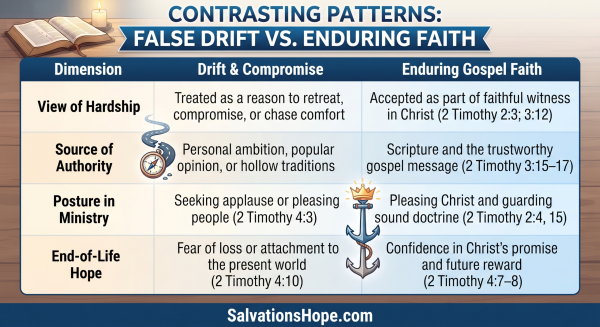
Practical Application for Today
Standing strong in tough times begins with honest self-examination and daily reliance on Christ. Open the Scriptures regularly, test every teaching against the clear gospel of Jesus Christ, and stay rooted in a faithful community where believers encourage one another to persevere. Look to Jesus—the author and finisher of faith—rather than any human leader or earthly security, trusting Him to sustain you until the finish line.
Terrible Times

Facing Reality and Standing Apart in the Last Days
Paul writes his second letter to Timothy under the shadow of imminent execution, knowing his earthly ministry is ending and that young Timothy faces fierce spiritual opposition. Rather than offering false comfort or predicting an easy path ahead, Paul anchors Timothy in clear-eyed realism: the last days bring intense moral decay, hostility toward the gospel, and deceptive counterfeit religion. Yet the call to Timothy—and to every believer—is unmistakable: face the truth of the times without flinching, refuse to drift with the surrounding culture, and stand strong in the faith.
“This know also, that in the last days perilous times shall come. For men shall be lovers of their own selves, covetous, boasters, proud, blasphemers, disobedient to parents, unthankful, unholy, without natural affection, trucebreakers, false accusers, incontinent, fierce, despisers of those that are good, traitors, heady, highminded, lovers of pleasures more than lovers of God; having a form of godliness, but denying the power thereof: from such turn away.” (2 Timothy 3:1–5)
Understanding “The Last Days” Biblically
“The last days” is not a speculative countdown to a hidden calendar date or a few final months before Christ returns. In biblical theology, the last days began with Christ’s first coming—His death, resurrection, and ascension—and span the entire period until His second coming.
A season of simultaneous advance and resistance: As the gospel goes forth into the world, opposition to truth and moral rebellion against God intensify rather than quietly fading away.
No naive expectation of effortless acceptance: Proclaiming Christ will not turn every culture or institution into sweetness and light; believers must expect friction, misunderstanding, and outright hostility.
Shared urgency across generations: What was true in Timothy’s first-century world remains true today—hardship in the last days is a recurring feature of the age between Christ’s advents, not an isolated novelty.
The Peril of “Rotten Religion”
One of the sharpest dangers Paul highlights is not open atheism from outside the church, but hollow, corrupt religion operating under a Christian veneer. People can use the language, titles, or trappings of faith while rejecting the gospel’s regenerating, transforming power.
“These men also oppose the truth, men corrupted in mind and disqualified regarding the faith.” (2 Timothy 3:8)
Constant study without arriving at truth: Paul warns of those who are “always learning and never able to arrive at a knowledge of the truth” (2 Timothy 3:7). Endless academic debate, novel theories, and dense publications can mask a refusal to submit to plain biblical truth—even while many faithful, Bible-believing institutions and scholars continue to contend earnestly for the faith.
Unconverted teachers in positions of influence: It is a sobering reality that individuals holding prominent religious chairs or leading large followings can lack personal faith in Christ and even deny foundational truths like the physical resurrection of Jesus.
Spiritual corruption spreads to others: False religion does not stay contained in books or lecture halls; it can capture sincere followers, dull spiritual discernment, and turn people away from sound doctrine (2 Timothy 3:5–6).
The Turning Point: “But You”
Standing strong begins with refusing denial. Believers must look honestly at the age’s evil and the reality of human sin without becoming cynical, defeated, or conformed to the crowd.
Rejecting the cultural and religious current: When Paul finishes cataloging selfish, boastful, pleasure-loving, and counterfeit-religious behavior, he pivots directly to Timothy with a decisive contrast—often rendered “But you” or “As for you” (2 Timothy 3:10, 14).
Choosing distinctness over blending in: Knowing the tide is pulling people toward compromise is precisely why believers cannot simply drift along with popular trends or fashionable redefinitions of Christianity.
Steadfastness rooted in truth: Standing firm means holding fast to what Scripture has faithfully taught and tested, even when it costs popularity, comfort, or status.
Counterfeit Drift vs. Distinct Faithfulness

Practical Application for Today
Do not be surprised when tough times test the church or when polished voices promote a gospel stripped of Christ’s authority and power. Examine your own heart and convictions against Scripture, refuse to let popular opinion or academic novelty replace clear biblical truth, and keep your eyes fixed on Jesus Christ. By facing reality honestly and standing firmly in the gospel’s grace and truth, you can remain unshaken as everything around you shifts.
Standing Strong

Seven Pillars for Faithful Ministry in Paul’s Letters to Timothy
Few things clarify a young pastor—or anyone stepping into gospel ministry—more than counsel from a seasoned apostle who has carried the weight of churches, suffered for Christ, and stands near the end of his race. In his letters to Timothy, Paul outlines seven concrete markers of standing strong so that leaders and believers alike can persevere without losing heart or compromising the truth.
“Join with me in suffering, like a good soldier of Christ Jesus.” (2 Timothy 2:3)
Figure on a Fight and Endure for the Elect
Faithful ministry is not a peaceful stroll; it is active participation in spiritual warfare and the advance of the gospel. Paul calls Timothy to brace for opposition while viewing every hardship through the lens of eternal salvation for God’s chosen people.
- Figure on a fight: Expect conflict, misunderstanding, and resistance rather than treating opposition as a surprise setback (1 Timothy 1:18; 2 Timothy 2:3).
- Endure for the elect: Bear suffering patiently so others may obtain salvation in Christ Jesus with eternal glory (2 Timothy 2:10).
Stick to Scripture and Model Your Message
Standing strong requires anchoring both teaching and personal character in the living Word of God. Doctrine without a matching life invites hypocrisy, while a godly life without sound doctrine leaves the flock unprotected.
“Watch your life and doctrine closely. Persevere in them, because if you do, you will save both yourself and your hearers.” (1 Timothy 4:16)
- Stick to Scripture: Preach, teach, and rebuke from God-breathed Scripture rather than chasing novelty, speculation, or popular applause (1 Timothy 4:13; 2 Timothy 3:16–17; 4:2–3).
- Model your message: Set an example in speech, conduct, love, faith, and purity so your life corroborates the gospel you proclaim (1 Timothy 4:12; 2 Timothy 3:10).
Teach More Teachers, Look to the Lord, and Focus on Forever
Longevity in ministry depends on multiplying faithful workers, relying on Christ’s sustaining presence, and keeping eternity in view. Paul charges Timothy to invest in reliable others while anchoring his hope beyond earthly outcomes.
- Teach more teachers: Entrust sound teaching to faithful men and women who are qualified to teach others (2 Timothy 2:2).
- Look to the Lord: Draw strength from Christ Jesus' grace, and trust the Lord, who rescues and stands beside His servants when human support fails (2 Timothy 2:1; 4:17–18).
- Focus on forever: Fix your eyes on the crown of righteousness and eternal life in Christ rather than temporary applause or present comfort (1 Timothy 6:19; 2 Timothy 4:7–8).
Fragile Ministry vs. Enduring Pastoral Strength
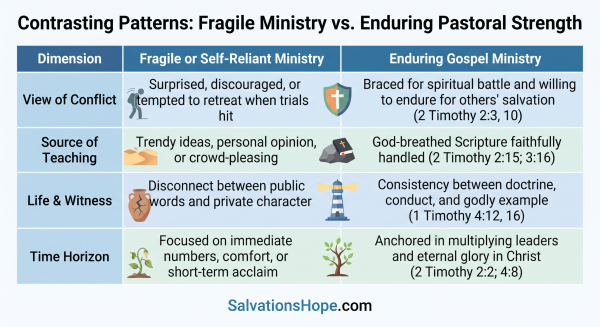
Practical Application for Today
Whether you are just entering pastoral ministry or have served for years, let Paul’s seasoned counsel steady your steps. Open the Scriptures daily, examine your life and teaching with humility, invest in raising up other faithful teachers, and keep your eyes fixed on Jesus Christ and eternity. He who called you into the work will faithfully sustain you to the end.
Figure on a Fight

Soldierly Endurance and Gentle Rescue
To stand strong in the last days, a servant of Jesus Christ must be prepared to fight—expecting real hardship, opposition, and persecution rather than an easy road. Yet biblical warfare never licenses harshness or personal retaliation; it is a battle against spiritual powers, fought with patient, gentle instruction aimed at setting deceived captives free.
“Endure hardship with us like a good soldier of Christ Jesus.” (2 Timothy 2:3)
Expect Real Combat, Not an Easy Passage
A soldier does not enlist expecting peacetime comfort without ever seeing battle, and a follower of Christ should not be shocked when opposition arrives. Paul warns Timothy plainly that godliness in a hostile age brings trials, hostility, and deception.
will go from bad to worse, deceiving and being deceived.” (2 Timothy 3:12–13)
- Persecution accompanies godly witness: Living faithfully for Jesus in a fallen world invites pushback rather than universal applause (2 Timothy 3:1, 12).
- Deception intensifies rather than fades: Evil people and impostors both deceive others and are themselves deceived, making spiritual alertness essential (2 Timothy 3:13).
- Shock weakens readiness: Assuming the Christian life or pastoral ministry will be easy leaves believers unprepared when hardship strikes (2 Timothy 2:3).
Recognize the True Enemy Behind Opposition
Paul reminds believers elsewhere that our struggle is not merely against flesh and blood, but against spiritual rulers, authorities, powers of this dark world, and spiritual forces of evil (Ephesians 6:12). Seeing spiritual realities clearly keeps believers from treating every opponent as merely a personal rival to crush.
The battle is spiritual at its root: Behind human opposition stands the devil and his demonic forces seeking to resist the gospel and capture souls (2 Timothy 2:26; Ephesians 6:12).
Opponents are often captives in a trap: Many who resist the truth are captive to the devil and do his will, blinded to the cruel master they serve (2 Timothy 2:26).
Retaliation misses the mission: Lashing out in anger only hardens resistance instead of helping people see the truth and escape deception (2 Timothy 2:24–26).
Fight Well Through Gentle Instruction for Repentance
Christlike self-control, patience, and gentle teaching—not belligerence—prove strength in spiritual warfare. Paul directs the Lord’s servant to instruct opponents gently, trusting God to grant repentance and bring captives to the knowledge of the truth.
(2 Timothy 2:25–26)
- Gentleness paired with conviction: Firmness in truth never requires cruelty in tone; gentle instruction opens doors that harshness slams shut (2 Timothy 2:24–25).
- Repentance is a gift from God: Believers faithfully plant and instruct, praying that God grants repentance and awakens deceived minds to the truth (2 Timothy 2:25).
- Rescue is the goal of the fight: Winning an argument is hollow if a soul remains trapped; true ministry seeks to help captives come to their senses and enter the freedom of Christ (2 Timothy 2:26).
Fleshly Combat vs. Christlike Warfare
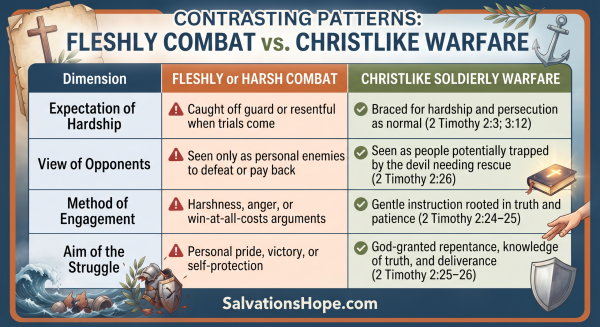
Practical Application for Today
In a fight, stand firm in Christ’s truth, refuse to be shaken by opposition, and don’t shrink back when living godliness costs you. At the same time, guard your spirit against harshness and resentment, remembering that many who oppose the gospel are prisoners in need of grace. By holding fast to Christ while gently pointing deceived people to the truth, you fight the battle in a manner worthy of your Lord.
Enduring for the Elect

Divine Election and Perseverance in Ministry
Faithful gospel ministry is never wasted, even when opposition mounts, false teachers gain traction, and apparent converts fall away. Paul anchors Timothy’s endurance in God’s sovereign grace: because the Lord has chosen a people for Himself and uses faithful witnesses to bring them to salvation and sustain them to the end, gospel labor cannot ultimately fail.
Paul declares in 2 Timothy 2:10 that he willingly bears every hardship for the sake of those whom God has chosen, so they too may receive the salvation found in Christ Jesus along with eternal glory.
God’s Elect Guarantee That Gospel Labor Is Not in Vain
When trials pile up, and immediate results look bleak, a pastor or believer can be tempted to conclude that faithful witness is futile. Yet the doctrine of divine election gives ministry an unshakable horizon: God has already determined to save a people through the proclamation of Christ, and He appoints human instruments to carry out that saving purpose.
Purpose behind every trial: Hardship is not meaningless punishment or proof of abandonment when borne for the sake of the gospel and God’s chosen people (2 Timothy 2:10; Colossians 1:24).
Means to salvation and perseverance: God uses faithful teaching, prayer, and patient witness not only to call His elect to saving faith in Christ, but also to keep them steadfast until the end (2 Timothy 2:10; John 10:27–29).
Encouragement at the breaking point in Corinth: In Acts 18:9–10, when Paul faced intense pressure and the temptation to move on quickly, the Lord appeared to him at night and told him not to be afraid or stay silent, assuring him that God had many people in that city whom He would gather.
False Teaching Spreads Like Gangrene, Yet God’s Foundation Stands
Scripture refuses to gloss over the destructive spread of error inside visible religious spaces or the painful reality of apostasy. False teaching acts like an infection that festers and spreads if left unchecked, destabilizing fragile faith and breaking the hearts of shepherds who watched people drift away from sound doctrine.
In 2 Timothy 2:17 and 2 Timothy 2:19, Paul warns that ungodly chatter and false teaching spread like gangrene, even while God’s solid foundation remains unshaken, bearing the seal that the Lord knows those who belong to Him.
The destructive reach of error: False teaching erodes spiritual health like gangrene, often drawing crowds or appearing successful in the short term while poisoning true understanding of Christ (2 Timothy 2:16–18; 1 Timothy 4:1).
The pain of defection and disappointment: Watching people who once professed faith turn away—or seeing spiritually hollow movements flourish—can provoke the troubling question of why God allows error to grow so visibly.
The unshakable seal of divine ownership: Even when outward appearances confuse human observers, God’s foundation does not crumble; He infallibly knows His own and guards His true flock (2 Timothy 2:19; John 6:37–40).
Holding Steady Amid Confusion and False Success
Corrupt teaching and visible defection call for sober-mindedness, not panic or cynicism. A faithful servant of Christ measures truth not by crowd size, institutional polish, or the temporary spread of error, but by fidelity to God’s Word and trust in God’s sovereign care.
Keep your head in turbulent seasons: External noise, shifting religious trends, and troubling defections should sharpen spiritual focus rather than drive believers into despair or compromise (2 Timothy 2:14–19).
Stick to God’s message without dilution: The antidote to gangrenous error is clear, unvarnished gospel truth that points sinners to repentance and faith in Jesus Christ alone (2 Timothy 2:15; 4:2).
Do God’s work patiently: Continuing to preach, teach, and care for souls—trusting the Spirit to awaken God’s chosen—aligns human effort with divine promise (2 Timothy 2:10, 24–25).
Measuring by Appearances vs. Enduring for the Elect
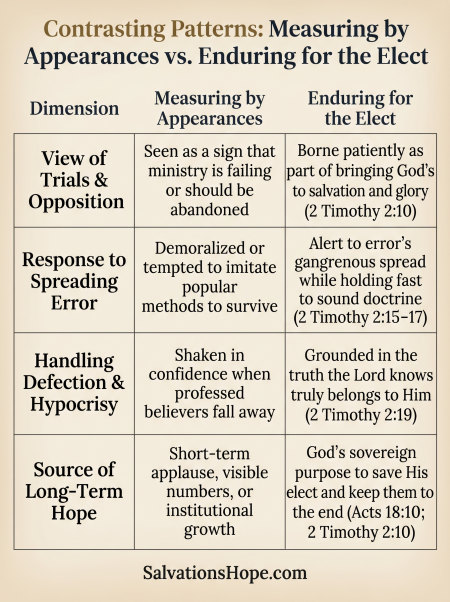
Practical Application for Today
When ministry feels heavy, progress seems slow, or false teaching gains ground, remember that the outcome belongs to the Lord. Keep your head clear, stay anchored in the true gospel message, and press on with patient love for those around you—knowing God has His chosen people and will use your faithful endurance to draw them to Christ and keep them secure in His grace.
Stick to Scripture

Preaching and Guarding God-Breathed Truth
Standing strong in tough times requires an unshakeable commitment to the written Word of God as the decisive authority for faith, life, and ministry. Paul charges Timothy to make Scripture the center of public worship, personal spiritual formation, and pastoral correction—refusing to trade eternal truth for cleverness, personal prestige, or crowd-pleasing novelty when listeners turn away from sound doctrine.
“Devote yourself to the public reading of Scripture, to preaching, and to teaching.” (1 Timothy 4:13)
Make Scripture the Center of Public Ministry and Personal Wisdom
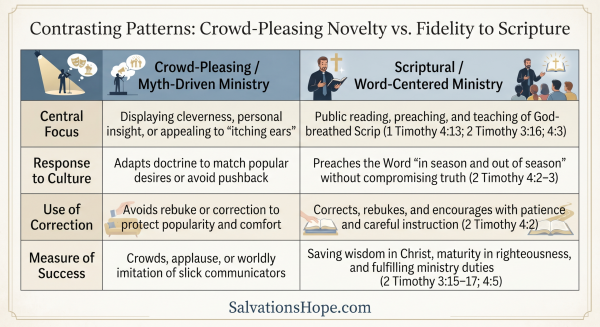
A minister of the gospel does not stand before God’s people to showcase personal brilliance, clever rhetoric, or vast human knowledge. The congregation’s deepest need is not to hear how smart the speaker is, but to hear God Himself speak through His Word—read aloud, proclaimed faithfully, and explained with care.
Public reading, preaching, and teaching: Paul calls Timothy to anchor gatherings in the public reading of Scripture, so hearers recognize it as God’s truth, followed by exposition and teaching that unpacks its actual content (1 Timothy 4:13).
Rooted in a heritage of faith: Timothy’s mother and grandmother passed on the holy Scriptures from his infancy, showing that early, consistent exposure to the Bible lays a durable foundation (2 Timothy 1:5; 2 Timothy 3:15).
Wisdom for salvation in Christ: The ultimate goal of Scripture is not mere academic trivia or moralistic self-improvement, but making a person “wise for salvation through faith in Christ Jesus” (2 Timothy 3:15).
Thoroughly equipped for every good work: Because all Scripture is God-breathed (theopneustos), it carries divine authority and is sufficient to teach doctrine, rebuke error, correct sin, and train believers in righteousness, so the servant of God is fully equipped for every good work (2 Timothy 3:16–17).
Preach in Season and Out of Season Amid “Itching Ears”
Faithfulness to Scripture is tested most sharply when cultural taste shifts away from biblical truth. Paul warns Timothy that a time comes when people refuse sound doctrine, assemble teachers who cater to their own desires, and trade truth for myths—yet the true minister keeps his head and keeps preaching the Word regardless of the climate.
(2 Timothy 4:2)
Two seasons, one mandate: There are only two seasons in ministry—when people welcome the Word and when they resist it (“in season and out of season”)—and in both seasons the duty is identical: preach the Word (2 Timothy 4:2).
Patient instruction over harshness: Correcting, rebuking, and encouraging must be done with great patience and careful instruction, not impatience or shallow slogans (2 Timothy 4:2).
Resisting the temptation of “itching ears”: False teachers inside and outside the church—alongside voices from other religions—gain followers by telling audiences what they want to hear, turning people away from truth toward myths (2 Timothy 4:3–4).
Refusing envy or imitation: Slick communicators who trade truth for applause or crowd size may draw attention, but a servant of God must neither envy their popularity nor copy their methods, keeping a clear head and fulfilling every duty of ministry (2 Timothy 4:4–5).
Why Experience and Doctrine Must Stay Joined
Timothy’s call to stick to Scripture is reinforced by what God’s Word has already accomplished in his own life. Having seen how Scripture first brought him to saving faith in Christ and then matured him over time, Timothy knows the same Word can rescue and grow others.
Personal transformation validates the message: When a pastor has personally experienced the gospel’s saving and sanctifying power, he preaches not as a detached lecturer but as a witness to living truth (2 Timothy 3:14–15).
Doctrine shapes both shepherd and flock: Standing on Scripture guards the preacher from drifting into error while giving the congregation a reliable standard that outlasts shifting opinions (1 Timothy 4:16; 2 Timothy 3:16–17).
A distinct calling apart from entertainment: Entertainers and religious salesmen measure success by immediate audience approval, whereas a minister of God measures faithfulness by fidelity to the text and obedience to Christ (2 Timothy 4:2–5).
Crowd-Pleasing Novelty vs. Fidelity to Scripture
Practical Application for Today
Commit yourself afresh to the plain, faithful ministry of God’s Word—read it publicly, expound it accurately, and let it shape your own life before you ask others to follow it. Do not be seduced by flashy trends, spiritualized myths, or teachers who scratch itching ears for applause. Whether the surrounding culture applauds or pushes back, keep your head clear, stick to Scripture, and trust the living Word of God to save, equip, and sustain His people.
Model Your Message

Aligning Life and Doctrine in Gospel Ministry
Standing strong in tough times requires more than accurate preaching—it demands a life that visibly matches the gospel you proclaim. Paul calls Timothy not only to teach sound doctrine and rightly handle the Word of truth, but also to embody the life of Christ so hearers both hear the truth and see it lived out.
“Command and teach these things. Don’t let anyone look down on you because you are young, but set an example for the believers in speech, in life, in love, in faith and in purity.” (1 Timothy 4:11–12)
Authority Grounded in Example, Not Age or Status
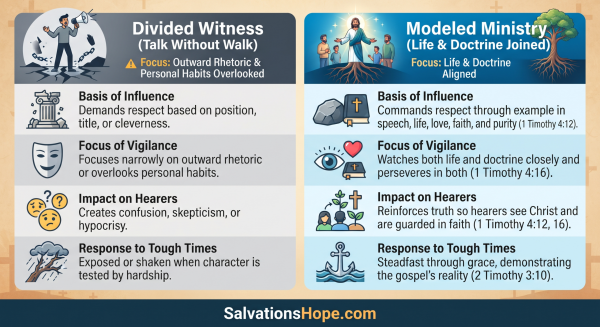
A young leader—or any servant of Christ—cannot rely on seniority or title to command spiritual respect. True pastoral authority flows from faithful teaching paired with a credible, Christlike example that silences dismissal and builds trust.
- Don’t let youth or inexperience invite contempt: Respect comes from fidelity to Christ and godly character, not age alone (1 Timothy 4:12).
- Five arenas of example: Paul directs Timothy to model Christlikeness in speech, conduct ("life"), love, faith, and purity (1 Timothy 4:12).
- Walking the walk, not just talking the talk: Verbal instruction loses moral weight when daily behavior contradicts the message being taught (1 Timothy 4:12, 16).
Guarding Both Life and Doctrine Closely
Sound teaching and godly living are inseparable twins in Paul’s pastoral theology. Neglecting doctrine exposes the church to error, while neglecting personal holiness undermines the messenger’s credibility and wounds the flock.
“Watch your life and doctrine closely. Persevere in them, because if you do, you will save both yourself and your hearers.” (1 Timothy 4:16)
Handling the Word of truth rightly: Faithful teachers must study and communicate Scripture accurately, avoiding distortion or carelessness (2 Timothy 2:15; 1 Timothy 4:16).
Self-scrutiny before public ministry: Watching one’s own heart, habits, and motives keeps the messenger spiritually healthy and accountable (1 Timothy 4:16).
Perseverance carries eternal weight: Continuing steadily in both life and doctrine is God’s appointed means to preserve both the minister and those who listen (1 Timothy 4:16).
Why Hearers Need to See Christ in You
People are shaped not only by the words spoken from a pulpit or teaching setting, but by the tangible presence of grace in the teacher’s life. When believers see Christ’s life reflected in speech, love, and purity, the message of Christ becomes far more compelling and believable.
Hearing and seeing work together: Hearers need the clear Word of God spoken to them and that Word’s living reality displayed before them (1 Timothy 4:12, 16).
Credibility under pressure: Tough times test whether a leader’s faith is real; consistent Christlikeness shows that the gospel holds up under strain (2 Timothy 3:10–11).
Pointing away from self to Christ: Modeling the message isn’t self-righteousness; itis letting Christ’s life shine through a yielded servant (1 Timothy 4:12).
Divided Witness vs. Modeled Ministry
Practical Application for Today
Do not treat doctrine and daily conduct as separate compartments of your life. Ask God to examine your speech, relationships, faith, and purity alongside your study and teaching of Scripture, and persevere in both with humility. When your life and your message align in Christ, your witness carries steady strength in every season.
Train More Teachers

Reproducible Leadership and Passing the Baton of Truth
Standing strong in tough times requires refusing the temptation to carry gospel ministry alone or treat truth as a private possession. Paul instructs Timothy to appoint qualified elders and deacons, honor faithful shepherds, guard the entrusted deposit of the gospel with the Holy Spirit’s help, and deliberately train reliable men and women to teach others—securing both the present church and the next generation against rising evil.
“You then, my son, be strong in the grace that is in Christ Jesus. And the things you have heard me say in the presence of many witnesses entrust to reliable men who will also be qualified to teach others.” (2 Timothy 2:1–2)
Selecting Leaders Whose Faith, Character, and Families Are Worth Reproducing
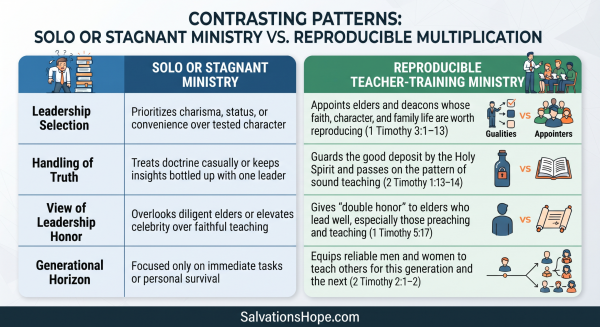
A church cannot grow healthy or withstand spiritual pressure if it chooses leaders merely for charisma, administrative polish, or popularity. Throughout 1 Timothy 3, Paul lays out clear qualifications for elders and deacons so that the church is led by men and women whose lives provide a trustworthy pattern for the flock to follow.
Accurate faith and sound teaching: Leaders must hold firmly to the trustworthy gospel message and instruct and uphold sound doctrine rather than invent novelty or compromise essential truth (1 Timothy 3:2, 9; Titus 1:9).
Exemplary personal character: Self-control, integrity, above-reproach conduct, and freedom from greed or hostility establish credibility when the church faces moral and cultural testing (1 Timothy 3:2–3, 8).
Homes that model gospel order: A leader’s household life—managing family well and raising children in respect and order—serves as a visible preview of how healthy, grace-shaped families can flourish in the church (1 Timothy 3:4–5, 12).
Reproducible patterns rather than isolated stars: Look for believers whose faith, conduct, and family witness are healthy enough to imitate without harming others, then invest time in training them further (1 Timothy 3:1–13; 1 Corinthians 11:1).
Guarding the Good Deposit and Refusing to Drop the Baton
Gospel truth is not a fluid opinion to be reshaped by every cultural wave; it is a precious deposit entrusted to the church to keep intact and pass forward. Like runners in a relay race who lose everything if they drop the baton, believers must hold fast to sound doctrine with the indwelling Spirit’s power and hand it cleanly to those who follow.
“What you heard from me, keep as the pattern of sound teaching, with faith and love in Christ Jesus. Guard the good deposit that was entrusted to you—guard it with the help of the Holy Spirit who lives in us.” (2 Timothy 1:13–14)
A clear pattern of sound teaching: The gospel has definite content and shape, held fast in faith and love in Christ Jesus, not cold intellectualism or loose compromise (2 Timothy 1:13).
Spirit-empowered stewardship: Guarding the deposit is not achieved by human stubbornness alone; it depends on the Holy Spirit dwelling within believers to preserve truth and courage (2 Timothy 1:14; 2 Timothy 1:7).
No dropping the baton between generations: Just as Paul poured truth into Timothy, Timothy must hold the deposit securely and pass it to the next wave of believers before earthly life ends (2 Timothy 1:13–14; 4:6–7).
Honoring faithful shepherds multiplies leadership: Recognizing elders who direct church affairs well—especially those laboring in preaching and teaching—with “double honor” affirms sound leadership and encourages more believers to pursue faithful, diligent service (1 Timothy 5:17–18).
Multiplying Teachers Across Generations in an Evil Age
Christ’s grace is meant to be shared outward, creating a multiplying chain of faithful instruction rather than a single bottleneck around one pastor. This generational vision—central to ministries like Salvation’s Hope Incorporated that equip reliable men to teach others thoroughly—prepares the church for the reality that evil will persist in future generations unless Christ returns first.
A four-link chain of multiplication: Paul teaches Timothy, who entrusts what he has heard to reliable men, who become qualified to teach others, who in turn instruct still more believers across congregations and eras (2 Timothy 2:2).
Strength rooted in grace, not self-sufficiency: Training others begins with being “strong in the grace that is in Christ Jesus,” recognizing that gospel power flows from Christ’s saving work and sustaining mercy (2 Timothy 2:1).
Preparing ahead for tomorrow’s battles: Because moral corruption and false teaching will continue into the next generation if the Lord tarries, raising up grounded, qualified teachers today is an act of strategic love for the church’s future (2 Timothy 2:2; 3:1, 13).
Solo or Stagnant Ministry vs. Reproducible Multiplication
Practical Application for Today
Don’t try to carry the entire weight of ministry alone, and don’t leave the next generation unequipped for the spiritual battles ahead. Prayerfully look for believers in your church or ministry whose faith, character, and family life are worth reproducing; honor those who labor faithfully in the Word; and intentionally teach them the pattern of sound doctrine. By standing strong in the grace of Christ Jesus and passing on the good deposit without dropping the baton, you help build a resilient chain of gospel witnesses that endures across generations.
Look to the Lord

Fixing Your Eyes on Triune Majesty and Unseen Reality
Standing strong in tough times is, above all, a matter of spiritual vision—keeping your eyes fixed on Jesus Christ, resting in God Almighty’s sovereign rule, and living in the strength of the Holy Spirit. When circumstances feel overwhelming, and opposition presses in from every side, Paul calls Timothy to lift his gaze above immediate trials and remember the living God who called him, equips him, judges all things, and reigns forever.
“Remember Jesus Christ, raised from the dead, descended from David. This is my gospel.” (2 Timothy 2:8)
Remember Your Calling, Fan the Spirit’s Flame, and Fight With a Good Conscience
Endurance in ministry begins with remembering who called you and what God has given you by grace,e rather than relying on fragile human bravado. Paul reminds Timothy of earlier prophetic affirmations over his calling and urges him to stir up his Spirit-given gift so fear does not quench his courage or compromise his integrity.
Follow your calling with faith and a good conscience: Paul charges Timothy to fight the good fight in alignment with the prophecies once spoken over him, holding fast to faith and a clear conscience so his spiritual warfare does not suffer shipwreck (1 Timothy 1:18–19).
Fan into flame what God has given: Spiritual gifts and gospel zeal can grow cold or dormant under pressure; Timothy must actively rekindle the gift of God bestowed through the laying on of hands (2 Timothy 1:6).
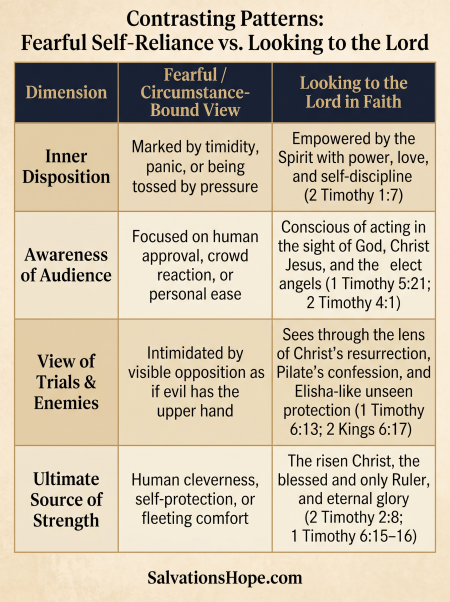
A Spirit of power, love, and self-discipline—not timidity: God has not given believers a spirit of cowardly fear or timidity, but a spirit of power, love, and sound self-control that steadies the heart against being blown around by opposition or panic (2 Timothy 1:7).
Anchor your identity in God’s appointment: Remembering God’s call and commission keeps a servant of Christ from shrinking back into self-doubt when trials test every nerve (1 Timothy 1:18; 2 Timothy 1:6–8).
Live and Preach Coram Deo—In the Sight of God, Christ, and the Angels
Paul repeatedly frames his instructions not as private advice between two men, but as solemn charges spoken coram Deo—in the presence of the living God, the Lord Jesus Christ, and the elect angels. Awareness of that heavenly audience strips away petty partiality, awakens holy urgency, and anchors every duty in eternal accountability.
and his kingdom, I give you this charge: Preach the Word.” — (2 Timothy 4:1–2)
No partiality or favoritism before God and the elect angels: Charging Timothy in the sight of God, Christ Jesus, and the holy angels reminds him that heaven witnesses how he handles church discipline, leadership, and justice without bias or personal favoritism (1 Timothy 5:21).
Preaching under the shadow of judgment and glory: Preaching the Word is never an optional performance; it is a sacred trust carried out before Christ, who will judge the living and the dead and whose appearing and kingdom are certain (2 Timothy 4:1–2).
Jesus’ faithful confession before Pontius Pilate: When pressure mounts, believers remember how Christ stood steadfast and made the “good confession” before Pontius Pilate, keeping His command without spot or blame until His appointed appearing (1 Timothy 6:13–14).
The blessed and only Ruler in unapproachable light: Paul lifts the church’s eyes to God—the life-giver, the blessed and only Sovereign, the King of kings and Lord of lords, dwelling in unapproachable light with eternal honor and might (1 Timothy 6:15–16).
Open Your Eyes to the Unseen Realities Like Elisha’s Servant
When hostile forces surround the people of God, natural sight can make danger look total and overwhelming. Paul’s steady gaze on Christ and the Father echoes 2 Kings 6:16–17, where Elisha calmed his terrified servant by declaring that more are with them than against them and praying, “Lord, open his eyes,” revealing chariots and horses of fire surrounding the prophet on every side.
Intimidating circumstances shrink beside God’s majesty: Looking solely at trouble and opposition tempts believers to think hardship is the whole story, whereas beholding God’s power reveals that His sovereign rule swallows up every threat (1 Timothy 6:13–16; 2 Timothy 4:17–18).
Seeing with spiritual eyes opened by grace: Although God dwells in unapproachable light that human eyes cannot behold on their own, the Lord opens the eyes of believers’ hearts to perceive His glory, power, and faithfulness in Christ (1 Timothy 6:16; 2 Kings 6:17).
Continuous communion with the Lord who watches and sustains: Standing strong is sustained by walking daily with the awareness that God and Christ see all and strengthen their servants to endure until eternity (2 Timothy 2:8; 4:17–18).
Fearful Self-Reliance vs. Looking to the Lord
Practical Application for Today
When tough times press in or spiritual opposition feels heavy, don’t let fear determine your steps or shrink your vision to immediate troubles. Fan into flame the grace and gifts God has given you, remember the risen Christ and His faithful witness, and ask the Lord to open your spiritual eyes to His sovereign majesty and power. Living and serving steadily before God and Jesus Christ gives you quiet strength for today and unshakable hope for forever.
Focus on Forever

Eternal Life, Faithful Endurance, and Finishing the Race
Standing strong in tough times means lifting our eyes above temporary pain, imprisonment, or cultural pressure and anchoring our lives in the gospel’s eternal reality. Writing from a Roman prison cell near the end of his earthly life, Paul shows Timothy—and every believer—that endurance is fueled by knowing Jesus Christ has conquered death, guarding eternal life for His people, and keeping eternity in view until the final day.
“Christ Jesus has destroyed death and has brought life and immortality to light through the gospel. And of this gospel I was appointed a herald, an apostle, and a teacher. That is why I suffer as I do. Yet I am not ashamed, because I know whom I have believed, and am convinced that he is able to guard what I have entrusted to him for that day.” — (2 Timothy 1:10–12)
Life and Immortality Brought to Light in Christ
Death is not the final word for those who belong to Jesus Christ, even when a faithful servant sits in chains awaiting execution. Through His death and resurrection, Christ dismantled death’s power and revealed eternal life and immortality through the gospel.
Christ’s triumph over death reshapes suffering: Paul endures hardship and chains as a herald, apostle, and teacher of the gospel without shame because he knows the risen Savior who holds his future (2 Timothy 1:10–12; 2 Timothy 2:8).
Confidence in the One who guards our deposit: Rather than clutching fragile earthly security, Paul entrusts his life, soul, and eternal hope to Christ, certain that He is able to guard what has been committed to Him until “that day” of final resurrection and judgment (2 Timothy 1:12, 18).
Immortality as a present anchor for hard days: Knowing that Christ has already brought eternal life and immortality to light keeps believers from treating passing trials as ultimate defeat (2 Timothy 1:10; 1 Timothy 6:19).
The Sobering Reality of Endurance, Reigning, and Disowning
An eternal perspective brings both rich promise and solemn warning, calling believers to genuine, persevering faith rather than casual presumption. Paul links endurance in this life directly to eternal fellowship and reigning with Christ, while warning against turning away and disowning the Lord.
he will remain faithful, for he cannot disown himself.” (2 Timothy 2:12–13)
Endurance leads to reigning with Christ: Those who persevere in faith and obedience through testing will share in Christ’s eternal kingdom and reign with Him forever (2 Timothy 2:12; Revelation 3:21).
Disowning Christ carries eternal loss: Deliberately rejecting or falling away from Christ brings the sobering consequence of being disowned by Him in eternal judgment and hell (2 Timothy 2:12; Matthew 10:33).
God’s faithfulness to His own character: Even when believers stumble or grow weak in faith, Christ remains true to Himself and His covenant promises—though persistent apostasy and denial of the Lord expose an unregenerate heart (2 Timothy 2:12–13; 2 Timothy 2:19).
Finishing Well and Longing for Christ’s Appearing
Paul’s final words in 2 Timothy capture a life poured out completely for Christ—not with bitterness or regret, but with peace, resolve, and eager expectation of the righteous Judge’s reward. Tragically, many ministers and believers stumble when trials hit or when the temptation to flatter “itching ears” proves too strong, making the desire to finish well one of a Christian’s most vital prayers.
“For I am already being poured out like a drink offering, and the time has come for my departure. I have fought the good fight, I have finished the race, I have kept the faith. Now there is in store for me the crown of righteousness, which the Lord, the righteous Judge, will award to me on that day—and not only to me, but also to all who have longed for his appearing.” (2 Timothy 4:6–8)
A life poured out like a drink offering: Paul views his impending death not as a wasted tragedy, but as a willing libation offered to God at the close of faithful service (2 Timothy 4:6; Philippians 2:17).
Fighting the good fight, finishing the race, keeping the faith: Finishing well means staying faithful to sound doctrine, enduring hardship, and holding fast to Christ to the finish line, rather than burning out or compromising halfway (2 Timothy 4:7; 2 Timothy 1:13–14).
The crown of righteousness for all who long for His appearing: The reward of the righteous Judge is not reserved for one apostle alone; it awaits every believer who loves and longs for Christ’s return, giving steady strength in every season of trial (2 Timothy 4:8; Titus 2:13).
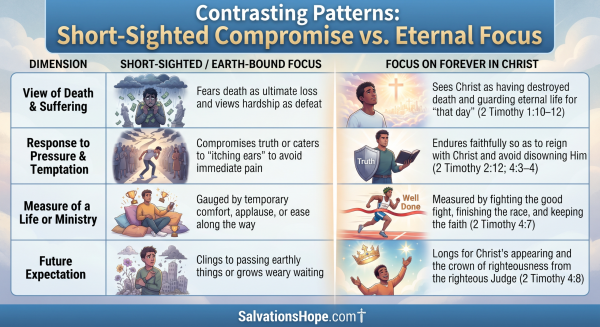
Short-Sighted Compromise vs. Eternal Focus
Recap of the Seven Pillars for Standing Strong in Paul’s Letters to Timothy
Across both letters to Timothy, Paul weaves these seven practical, Spirit-empowered pillars into a single call to steadfastness:
- Figure on a fight: Expect hardship and spiritual opposition, combatting error with patient, gentle instruction aimed at repentance and rescue from the devil’s trap (2 Timothy 2:3, 25–26; 3:12–13).
- Endure for the elect: Keep serving faithfully through trials and spreading error, trusting God’s sovereign purpose to save His chosen people and keep them to the end (2 Timothy 2:10, 17–19; Acts 18:10).
- Stick to Scripture: Devote ministry and life to reading, preaching, and teaching God-breathed Scripture in season and out of season rather than pandering to itching ears (1 Timothy 4:13; 2 Timothy 3:15–17; 4:2–4).
- Model your message: Align conduct with doctrine, setting an example in speech, life, love, faith, and purity so hearers see Christ’s life in you (1 Timothy 4:12, 16).
- Teach more teachers: Appoint qualified leaders, honor diligent shepherds, guard the entrusted gospel deposit by the Holy Spirit, and equip reliable believers to teach others across generations (1 Timothy 3:1–13; 5:17; 2 Timothy 1:13–14; 2:1–2).
- Look to the Lord: Remember your calling, fan into flame the Spirit’s gift of power, love, and self-discipline, and live in the sight of God and Christ with spiritual eyes opened to His majesty (1 Timothy 1:18–19; 5:21; 6:13–16; 2 Timothy 1:6–7; 2:8; 4:1).
- Focus on forever: Anchor your hope in Christ’s victory over death, persevere to reign with Him, and press on to finish the race looking for His appearing and the crown of righteousness (2 Timothy 1:10–12; 2:12–13; 4:6–8).
Practical Application for Today
Ask yourself honestly whether you live for the fleeting applause of the present moment or the eternal reward of Jesus Christ. Let the certainty of Christ’s resurrection, the reality of His coming appearing, and the promise of eternal life steady your heart when trials press hard. Keep fighting the good fight, hold fast to the faith, and fix your eyes on forever so that, by God’s grace, you finish well.
Delivered from the Lion’s Mouth

Preserving Witness, Overcoming Desertion, and Entering Glory
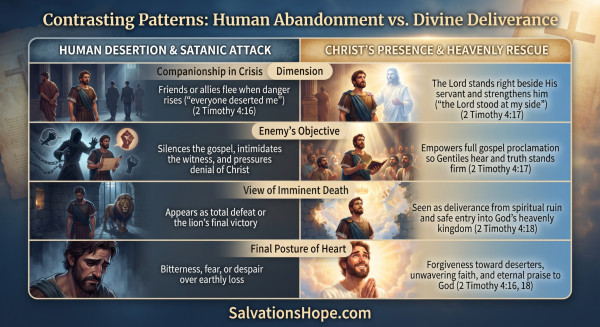
Shortly after penning his second letter to Timothy, the apostle Paul was executed by the sword in Rome—a historical tradition preserved by the early church historian Eusebius, consistent with Paul’s Roman citizenship sparing him crucifixion or prolonged torture. Yet even as his earthly life neared its violent end and human allies abandoned him at his first defense, Paul’s final words ring not with bitterness or terror, but with triumph: the Lord stood by him, strengthened his proclamation of the gospel, delivered him from the lion’s mouth, and guaranteed his safe arrival in God’s heavenly kingdom.
“At my first defense, no one came to my support, but everyone deserted me. May it not be held against them. But the Lord stood at my side and gave me strength, so that through me the message might be fully proclaimed and all the Gentiles might hear it. And I was delivered from the lion’s mouth. The Lord will rescue me from every evil attack and will bring me safely to his heavenly kingdom. To him be glory for ever and ever. Amen.” (2 Timothy 4:16–18)
Standing Alone When Human Allies Desert You
Facing imperial court proceedings and impending death is isolating enough without losing expected companions, yet Paul describes standing completely alone at his first defense when everyone deserted him. Rather than nursing resentment or turning his final letter into a bitter score-settling exercise, Paul responds with Christlike grace, praying that the desertion not be held against those who fled.
Desertion exposes human frailty, not gospel weakness: Even trusted coworkers and believers can buckle under intense fear or political pressure when the cost of standing with a prisoner for Christ becomes obvious (2 Timothy 1:15; 4:10, 16).
Grace toward those who fail under pressure: Asking that we not hold desertion against those who left aligns with the forgiving spirit of Jesus at the cross and Stephen under stoning (2 Timothy 4:16; Luke 23:34; Acts 7:60).
Companionship that cannot be taken away: When earthly helpers step back or disappear, the Lord Himself steps forward to stand at His servant’s side so the servant is never really alone (2 Timothy 4:17; Isaiah 41:10).
What “Delivered from the Lion’s Mouth” Means in Spiritual Warfare
At first glance, saying “I was delivered from the lion’s mouth” right before certain execution can sound paradoxical—how is a condemned prisoner delivered when death awaits? Biblically, the “lion’s mouth” points both to deadly peril (echoing Daniel’s deliverance in Daniel 6:22 and the roaring adversary of 1 Peter 5:8) and to Satan’s ultimate aim: forcing a believer to recant, compromise the gospel, or abandon Christ before the end.
Preserving faithful witness at the hour of trial: At his first hearing, the Lord gave Paul strength to fully proclaim the gospel and be heard by the Gentiles, rather than be silenced by fear or execution (2 Timothy 4:17).
Defeating Satan’s deeper trap of apostasy: The enemy wanted Paul to deny his faith, depart from the Lord, or tarnish his testimony under mortal threat; standing strong by God’s grace meant Satan did not win Paul’s soul or silence his witness (2 Timothy 4:17–18; 2:12).
A lasting legacy sealed in truth: Though Paul’s head was severed by the sword and his soul went immediately into the presence of Christ, his missionary foundation and his Spirit-inspired letters—including his urgent counsel to Timothy—endure as a living heritage for the church (2 Timothy 4:6–8, 18; Philippians 1:21–23).
Certain Rescue Into God’s Heavenly Kingdom
Paul’s confidence does not rest on escaping physical death in Rome; it rests on an unbreakable promise that no evil attack can sever him from God’s eternal salvation. Whether by preserving him for his appointed testimony or by receiving his departing soul into glory, the Lord brings His faithful servant safely home to His heavenly kingdom.
Rescue from every evil attack: Spiritual and physical hostility may strike hard in this fallen world, yet no evil assault can ultimately destroy a believer’s eternal standing in Christ (2 Timothy 4:18; Romans 8:38–39).
Safe passage into the heavenly kingdom: “Delivered from the lion’s mouth” looks beyond temporary survival to final glorification—being brought safely into God’s everlasting kingdom where suffering and persecution end forever (2 Timothy 4:18; 2 Peter 1:11).
Doxology at the end of the road: Paul closes his final charge with doxology—”To him be glory for ever and ever. Amen”—placing all honor on the Lord who sustains, rescues, and crowns His people (2 Timothy 4:18; 1 Timothy 1:17).
Human Abandonment vs. Divine Deliverance
Practical Application for Today
Take these letters of the senior apostle to heart as personal marching orders for whatever season of ministry or discipleship you are walking through today. When people let you down, opposition intensifies, or the road ahead looks steep, keep your eyes on the living God and listen to Paul’s steady voice echoing across the centuries: he has fought the good fight, finished the race, and kept the faith—and now he calls you to endure hardship like a good soldier of Jesus Christ, trusting the Lord to stand with you, guard your witness, and bring you safely into His heavenly kingdom.
Doctrine:
- Why Study Doctrine?
- Doctrine Of Salvation
- Doctrine of Scripture
- Doctrine of the Holy Spirit
- Doctrine Of The Trinity
- Doctrine of Angels and Demons
- Doctrine of Godly Living
- Doctrine of Witness and Worldview
- Doctrine of the Future
- Doctrine of the Church
- Doctrine of Humanity
- The Preeminence of Christ
- The Cup
- Counterfeit Unity
- Ten Things To Know
- The Golden Age
- Creatio Ex Nihilo
- Cosmic Conflict
- Miracles of Jesus
- Deacons?
- Role Of Elders
- The Divine Calculus of Eternity
- Designated Man
Theology:
- Does God Exist?
- Sin
- Millennium
- The Rapture
- God’s Book
- God In Three Persons
- Theology: New Testament
- Anchored in History
- Sower, Seed, and Soil
- Educated Fools
- Gift of Tongues
- Dying to Live
- KJV Only
- Yada Yada Yada
- Buried Anger
- Divine Mirror
- The Modern Dilemma
- Holy Hunger
- The Blunder of Pride
- Unveiling the Truth
- The Exalted Christ
- Willful Unbelief
- The Last Days
Learn:
- Ha’ay Jude!
- Redemptive Radiance
- Chief Potter
- The Eye
- Mr. Wonderful
- The Shadow Dynasty
- Prayer
- One Body, One Blood
- Where Are You, God?
- The Trap
- A Troubled Monopoly
- A Look At The Early Church
- Seasoned & Shining
- Divine Drama
- “Buried” Word
- Babel to Pentecost
- Politics of Envy
- Entitled Child?
- Sense Of Entitlement
- Brood Of Vipers
- The Victorious King
- Facing Your Funeral
- Zombie Church
Warfare:
- Call To Arms
- Guarding The Flock
- The Fiery Darts
- Satan’s Realm
- Demons Who Devour
- A Nation Under Wrath
- Wolves Among Us
- Satan-Demons
- Idol Breaker
- Anatomy of Wickedness
- Supreme Gift
- Sword of The Spirit
- A Modern Nero
- Discipline of the Ear
- Seduced By The World
- Silencing the Accuser
- Master of Falsehood
- Symphony of Murmuring
- The Curse of Canaan
- Born To Save
- Born in Poverty
- Spiritual Darkness
- False Messengers